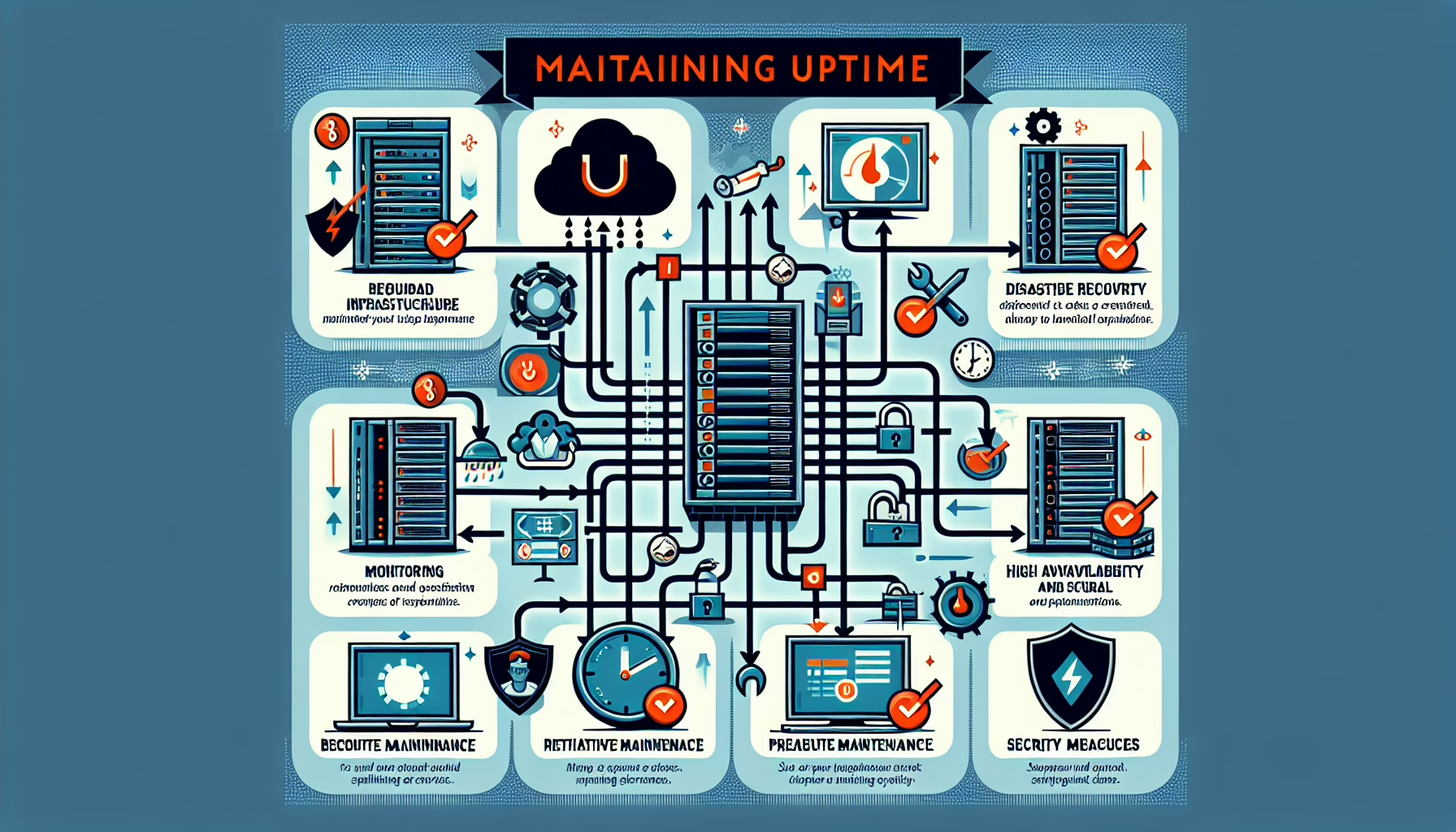
1. Redundant infrastructure
- Power: Deploy UPS units, backup generators, and dual power feeds for continuous supply.
- Network: Use multiple ISPs and redundant paths (BGP) to prevent connectivity loss.
- Cooling: Implement N+1 or 2N cooling redundancy to handle equipment heat during failures.
2. Disaster recovery and backup
- Back up critical systems and data regularly; store copies offsite or in cloud storage.
- Maintain a disaster recovery plan with RPO and RTO targets aligned to business requirements.
- Use failover mechanisms — load balancers, clustering, replication — for key services to minimize downtime.
3. Preventative maintenance
- Inspect and replace aging hardware (disks, fans, power supplies) on a schedule.
- Keep firmware, drivers, and software current to fix vulnerabilities and improve stability.
- Clean air filters, monitor airflow, and verify cooling performance to prevent overheating.
4. Monitoring and alerts
- Run 24/7 monitoring (Nagios, Zabbix, Datadog, or equivalent) across systems, storage, network, and environmental sensors (temperature, humidity).
- Configure real-time alerts for hardware failures, high CPU/memory, storage thresholds, and abnormal traffic patterns.
5. High availability and virtualization
- Use hypervisors (VMware, Hyper-V, KVM) to enable live VM migration during host failures.
- Implement HA clustering for critical applications and databases to eliminate single points of failure.
- Orchestrate containers with Kubernetes so workloads reschedule automatically when a node fails.
6. Security measures
- Physical: biometric access, surveillance, restricted entry to the datacenter floor.
- Cyber: firewalls, IDS/IPS, endpoint protection against threats.
- DDoS protection: deploy mitigation services to absorb volumetric attacks.
7. Capacity planning
- Track CPU, memory, storage, and bandwidth utilization to catch over- and under-provisioning early.
- Design for horizontal and vertical scaling so growth doesn’t require downtime.
8. Documentation and SOPs
- Maintain runbooks for common incidents and failure scenarios.
- Follow a change-management process (ITIL or equivalent) to prevent unplanned outages from config changes.
- Keep vendor contact lists current for emergency hardware/software support.
9. Regular testing
- Run failover and DR drills on a schedule to validate recovery procedures.
- Load-test systems to expose bottlenecks before they hit production.
10. Employee training
- Train the team on incident response, troubleshooting, and monitoring tool usage.
- Hold regular knowledge-sharing sessions on new technologies and operational practices.
11. Automation and telemetry
- Collect hardware telemetry (SMART, IPMI, vendor APIs) to spot degrading components before they fail.
- Automate routine tasks with Ansible, Puppet, Terraform, or similar tools to reduce human error.
12. Colocation and cloud integration
- Use cloud for non-critical workloads and as a DR target.
- Partner with colocation providers for additional redundancy or geographic expansion.
13. Regular audits
- Audit against standards (ISO 27001, PCI DSS, SOC 2) to verify compliance.
- Identify infrastructure and process gaps; remediate them proactively.

Ali YAZICI is a Senior IT Infrastructure Manager with 15+ years of enterprise experience. While a recognized expert in datacenter architecture, multi-cloud environments, storage, and advanced data protection and Commvault automation , his current focus is on next-generation datacenter technologies, including NVIDIA GPU architecture, high-performance server virtualization, and implementing AI-driven tools. He shares his practical, hands-on experience and combination of his personal field notes and “Expert-Driven AI.” he use AI tools as an assistant to structure drafts, which he then heavily edit, fact-check, and infuse with my own practical experience, original screenshots , and “in-the-trenches” insights that only a human expert can provide.
If you found this content valuable, [support this ad-free work with a coffee]. Connect with him on [LinkedIn].
Related Posts: