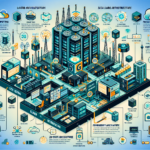
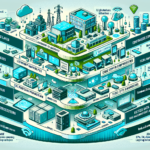
Implementing IT infrastructure for big data processing requires careful planning to ensure scalability, reliability, and performance. Below is a step-by-step guide tailored for an IT manager responsible for datacenters, storage, servers, virtualization, and related infrastructure:
1. Assess Business Requirements
Determine the volume, variety, and velocity of data you’ll be processing (the 3 Vs of big data).
Understand the use case: analytics, real-time processing, machine learning, AI, etc.
Define key performance indicators (KPIs) for your infrastructure (e.g., processing speed, uptime, scalability).
2. Core Infrastructure Design
a. Compute
Use high-performance servers with multi-core CPUs and large memory capacity.
For AI and machine learning workloads, deploy GPU-enabled servers (e.g., NVIDIA A100, H100, or similar).
Run hypervisors (VMware, Hyper-V) or container platforms (Docker, Kubernetes) to optimize compute utilization.
b. Storage
Implement a mix of storage types:
Object storage (e.g., S3, Ceph) for unstructured data.
Block storage (e.g., SAN or NVMe drives) for high-performance needs.
HDFS for distributed data processing.
Plan for horizontal capacity growth.
Establish a backup and disaster recovery strategy (e.g., using Veeam, Commvault).
c. Networking
Use 10GbE, 40GbE, or 100GbE network interfaces for fast data transfer between nodes.
Deploy high-performance switches with low-latency capabilities.
Segment traffic with firewalls, VLANs, and network segmentation to secure data.
d. Virtualization and Orchestration
Deploy Kubernetes clusters for containerized big data workloads. Tools such as Rancher or OpenShift can simplify Kubernetes management.
Use Docker for containerization if needed.
3. Big Data Frameworks
Install and configure frameworks based on your use case:
– Batch Processing: Hadoop, Apache Spark.
– Streaming: Apache Kafka, Apache Flink.
– Data Storage: MongoDB, Cassandra, Elasticsearch.
– Data Warehousing: Snowflake, Google BigQuery, Amazon Redshift.
4. AI and Machine Learning
If AI is part of your workload:
– Deploy GPU servers (e.g., NVIDIA CUDA-enabled systems).
– Use frameworks like TensorFlow, PyTorch, or RAPIDS for accelerated data processing.
– Enable the Kubernetes device plugin for GPU scheduling on containerized ML workloads.
5. Cloud Integration
Combine on-premise infrastructure with cloud services (AWS, Azure, or Google Cloud) for burst capacity.
Use cloud-based data lakes for economical storage and processing of large datasets.
Monitor spend with tools like AWS Cost Explorer or Azure Cost Management.
6. Automation
Use Infrastructure as Code (IaC) tools like Terraform or Ansible to automate provisioning and configuration.
Monitor workloads with Prometheus and Grafana for real-time insights.
7. Security
Implement role-based access control (RBAC) for data and infrastructure.
Encrypt data at rest and in transit.
Meet compliance requirements (GDPR, HIPAA, etc.) as applicable.
8. Monitoring and Optimization
Track infrastructure health with Nagios, Zabbix, or Datadog.
Optimize resource utilization with Kubernetes Horizontal Pod Autoscaler.
Run periodic performance tests to verify the infrastructure meets your KPIs.
9. Scalability
Design the architecture to scale horizontally (add more nodes) and vertically (upgrade existing nodes).
Use container orchestration to dynamically scale workloads based on demand.
10. Team and Skills
Ensure your team knows big data frameworks, Kubernetes, storage systems, and cloud technologies.
Provide training on emerging technologies such as AI/ML frameworks and GPU acceleration.
Example Architecture:
Compute: High-performance servers with GPUs for AI workloads.
Storage: Distributed file systems (HDFS, Ceph) and object storage (S3 compatible).
Ali YAZICI is a Senior IT Infrastructure Manager with 15+ years of enterprise experience. While a recognized expert in datacenter architecture, multi-cloud environments, storage, and advanced data protection and Commvault automation , his current focus is on next-generation datacenter technologies, including NVIDIA GPU architecture, high-performance server virtualization, and implementing AI-driven tools. He shares his practical, hands-on experience and combination of his personal field notes and “Expert-Driven AI.” he use AI tools as an assistant to structure drafts, which he then heavily edit, fact-check, and infuse with my own practical experience, original screenshots , and “in-the-trenches” insights that only a human expert can provide.