Critical vulnerabilities in the world’s most widely used web server demand immediate action, while NVIDIA launches compact AI desktops and exits the Chinese market. Google adds a new frontier-tier Gemini model, and researchers demonstrate a physical attack that bypasses TPM protections on Windows devices.
Listen to today’s briefing (podcast)
Key takeaways
NGINX HTTP/2 RCE flaws affect over 225 million sites; patch to 1.31.9 or 1.30.7 or disable HTTP/2 immediately.
NVIDIA RTX Spark compact desktops from ASUS, Dell, and MSI deliver up to 1 petaflop AI performance with 128GB unified memory, starting at $4,399.
NVIDIA confirms exit from China H200 sales, board-level national security committee, and $12.9B Hugging Face acquisition on track after Jensen Huang’s resignation.
Google releases Gemini 4 Neon with 1M-token context, tooling, and API pricing at $3/$15 per million input/output tokens.
Physical attack resets TPM lockout on AMD and some Intel PCs, cracking Windows Hello and BitLocker PINs in days with brief case access.
NGINX HTTP/2 RCE Vulnerabilities Allow Unauthenticated Server Takeover
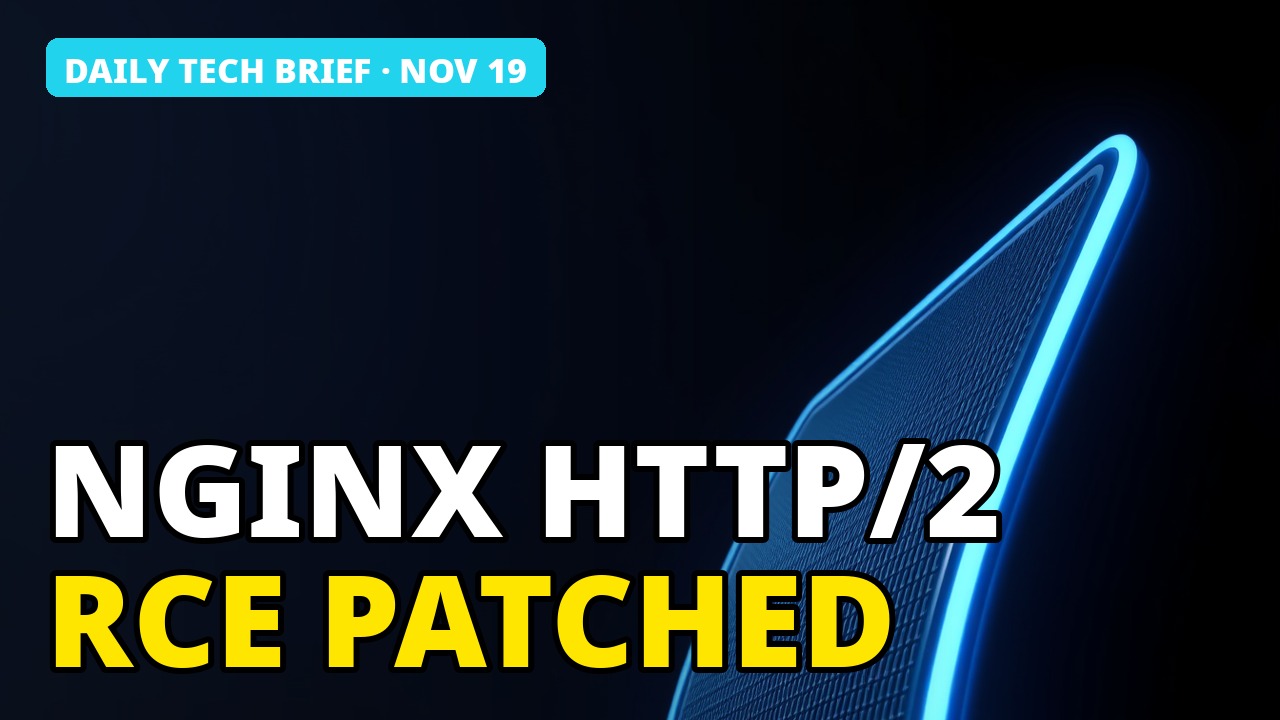
Two critical remote code execution vulnerabilities in NGINX’s HTTP/2 implementation, tracked as CVE-2026-123633 and CVE-2026-123007, carry a CVSS 4.0 score of 9.2 and affect every version since 1.9.5 released in September 2015 according to Wiz Newsroom. The decade-old flaw CVE-2026-123007, dubbed ‘nginx2root,’ allows unauthenticated attackers to execute code on any NGINX server with HTTP/2 enabled, even when serving only static files without backend applications or third-party modules as demonstrated by Wiz Research.
F5, the company behind NGINX, coordinated disclosure and released fixed versions 1.31.9 and 1.30.7 on November 18, 2026 per Siber Güvenlik Haberleri. Wiz Research, Ikotas Labs, Metnir, Rapid7, and Xint independently discovered the flaws in the open-source web server that powers more than 225 million websites worldwide according to Wiz Newsroom. Organizations should identify affected deployments and apply updates immediately; if upgrading is not possible, temporarily disable HTTP/2 as recommended by Wiz Newsroom.
Why it matters: These unauthenticated RCE flaws in the world’s most widely used web server enable immediate server takeover, data theft, and service disruption across over 225 million sites unless patched or HTTP/2 is disabled.
NVIDIA RTX Spark Compact Desktops Launch from ASUS, Dell, MSI with Local AI Agents
NVIDIA RTX Spark compact desktops from ASUS, Dell, and MSI are available today, featuring a 20-core Grace CPU, Blackwell RTX GPU with 6,144 CUDA cores, and up to 128GB of unified memory delivering up to 1 petaflop of AI performance according to NVIDIA Newsroom. The systems include 10-gigabit Ethernet for fast dataset transfers and run Windows with native CUDA support plus Linux tooling via WSL for local AI model inference, fine-tuning, and agent workflows as noted by NVIDIA Newsroom.
ASUS ProArt GR1X starts at $4,499 for 64GB/1TB configuration in a 1.15-liter chassis with dual-fan cooling sustaining 140W per StorageReview ASUS. MSI EdgeMesa N AI+ offers 128GB unified memory and 4TB PCIe Gen5 SSD at $7,499 MSRP according to StorageReview MSI. NVIDIA Switchyard in Hermes automatically routes agent tasks between local and cloud models to manage costs, while Blender 5.3, Adobe Premiere, and Substance 3D Painter gain RTX Spark optimizations per NVIDIA Newsroom. Mini PCs from Acer, GIGABYTE, HP, and Microsoft Surface RTX Spark Dev Box are coming soon according to The Verge.
Why it matters: These compact desktops provide a dedicated, always-on Windows platform for local AI inference and agent workflows with unified memory up to 128GB, reducing cloud API costs and data privacy concerns for developers and creators.
NVIDIA Abandons China Market, Confirms Leadership Change and Hugging Face Acquisition Plans
NVIDIA will no longer sell H200 chips in China, ending participation in a loophole brokered by former CEO Jensen Huang and President Trump that required U.S. shipment with a 25% tariff according to TechCrunch. Acting CEO Colette Kress announced a new board-level committee overseeing national security policies, export control compliance, and global trade risks the same day per TechCrunch. New rules issued Monday bar advanced U.S. chips from foreign data centers serving Chinese customers remotely, with Jefferies forecasting $44-62 billion revenue impact next year according to TechCrunch.
Chairman Harvey C. Jones confirmed the board unanimously accepted Huang’s resignation and does not intend to reinstate him after disclosure of personal behavior inconsistent with company standards, including an affair with a former Megaspeed executive suspected of being a Chinese intelligence agent per TechCrunch. Kress, also CFO and EVP, serves as interim CEO while the board searches for a permanent replacement according to TechCrunch. The $12.9 billion Hugging Face acquisition announced in September remains on track, with Kress citing a 35-fold year-over-year surge in weekly token volume on OpenRouter as evidence open models are accelerating AI adoption per TechCrunch.
Why it matters: NVIDIA’s China exit reshapes AI hardware availability under tightening export controls, while leadership transition and Hugging Face acquisition signal strategic shift toward open model ecosystems.
Google Releases Gemini 4 Neon Frontier Model for Development and Science
Google released Gemini 4 Neon today, promising frontier-level intelligence for complex software engineering, knowledge work, and science workflows with a 1-million-token context window and up to 1 million output tokens according to The Decoder. The multimodal model handles text, images, video, audio, and PDFs with built-in tooling including Computer Use, code execution, file search, and grounding via Google Search and Maps, though image and audio generation are not supported per The Decoder.
API pricing is $3 per million input tokens and $15 per million output tokens for Neon, while Carbon and Argon introductory rates are $2/$10 doubling to $4/$20 on December 1, and Hydrogen is priced at $1.50/$7.50 per million input/output tokens according to The Decoder. This marks Google’s fourth new Gemini 4 model in four weeks, with Neon positioned as a counterpart to Claude Opus or Sol equivalents per Simon Willison. Full specifications are in the documentation and benchmarks are expected shortly according to The Decoder.
Why it matters: Gemini 4 Neon provides a production-ready frontier-tier multimodal model with 1M-token context, integrated tooling, and explicit API pricing for complex reasoning, coding, and scientific workloads.
NVIDIA Accelerates Visual AI Agents on Jetson with VSS 3.3 and Cosmos
NVIDIA is hosting a hands-on livestream demonstrating a practical workflow for building visual AI agents at the edge using Video Search and Summarization (VSS) 3.3, Cosmos, and Jetson Agent Skills on the Jetson edge AI platform according to NVIDIA Newsroom Multimedia. Jetson Agent Skills help coding agents inspect target hardware, verify JetPack and container compatibility, and prepare the runtime environment as described in the livestream description.
VSS agent skills convert natural-language application requests into configured deployments, while Cosmos provides video understanding for event verification per NVIDIA Newsroom Multimedia. Learning objectives include checking device resources, configuring JetPack and inference environments, building visual AI applications from natural-language requests, unifying video search, alerts, and event review, and validating deployments under edge memory and compute constraints according to NVIDIA Newsroom Multimedia. Referenced resources include the VSS 3.3 Tech Blog, VSS GitHub, and Brev Launchable per NVIDIA Newsroom Multimedia.
Why it matters: This natural-language-driven workflow reduces development complexity and accelerates time-to-production for video analytics applications on edge hardware.
Physical Attack Bypasses TPM Lockout to Crack Windows Hello and BitLocker PINs in Days
Researchers at Technische Universität Berlin discovered that on AMD-based PCs and some Intel PCs, the TPM lockout for Windows Hello and BitLocker PINs can be reset by an attacker who opens the PC’s case according to Siber Güvenlik Haberleri. In lab tests, the researchers successfully extracted a four-digit Hello PIN from an AMD laptop and a six-digit BitLocker PIN from an Intel laptop using this method per Siber Güvenlik Haberleri.
Why it matters: Brief physical access allows attackers to bypass TPM lockout protections and crack short Windows Hello and BitLocker PINs in days rather than years, requiring reassessment of physical security policies.
Runpod — Runpod provides on-demand GPU infrastructure for developers who want to fine-tune or deploy models like Gemini 4 Neon. Try Runpod’s serverless GPUs to train, fine-tune, or deploy AI models without managing infrastructure. Try Runpod
n8n — n8n lets you visually design and run AI agent workflows locally or self-hosted, complementing the new RTX Spark desktops’ on-device agent capabilities. Try n8n to build and automate AI agent workflows on your new RTX Spark desktop or self-hosted infrastructure. Try n8n
RTX Spark Compact Desktop on Amazon — The story covers the launch of these new AI-focused desktops from ASUS, Dell, and MSI. See current options and reviews on Amazon. View on Amazon
Affiliate disclosure: some links in this description are affiliate links. If you sign up through them, SysArticles may earn a commission at no extra cost to you. We only mention tools that are relevant to the story. As an Amazon Associate I earn from qualifying purchases.
Today’s briefing spans critical infrastructure patches, new AI hardware categories, geopolitical shifts in chip supply, frontier model releases, edge AI tooling, and physical security bypasses — all demanding immediate attention from IT teams.
This briefing is produced with AI assistance from the linked primary sources. Narration uses a synthetic AI news-anchor voice, built with Higgs Materials licensed from Boson AI USA, Inc.
Ali YAZICI is a Senior IT Infrastructure Manager with 15+ years of enterprise experience. While a recognized expert in datacenter architecture, multi-cloud environments, storage, and advanced data protection and Commvault automation , his current focus is on next-generation datacenter technologies, including NVIDIA GPU architecture, high-performance server virtualization, and implementing AI-driven tools. He shares his practical, hands-on experience and combination of his personal field notes and “Expert-Driven AI.” he use AI tools as an assistant to structure drafts, which he then heavily edit, fact-check, and infuse with my own practical experience, original screenshots , and “in-the-trenches” insights that only a human expert can provide.