Today’s briefing covers a critical Windows zero-day exploit that grants SYSTEM privileges and NVIDIA’s new open robotics foundation model. Both developments demand attention from IT professionals and researchers alike.
Listen to today’s briefing (podcast)
Key takeaways
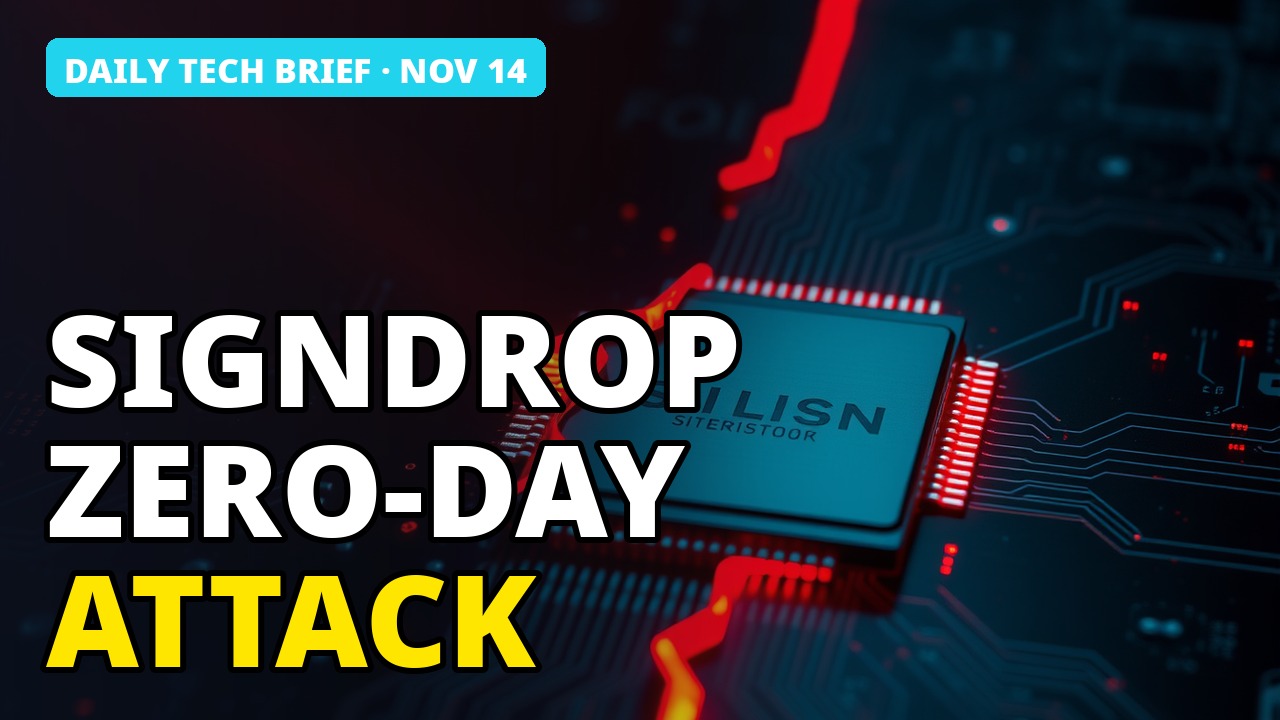
Windows SignDrop zero-day enables local privilege escalation to SYSTEM on most Windows versions, with no patch yet available.
NVIDIA’s GR00T 2 foundation model allows robots to learn skills from human demonstrations and transfer them across different embodiments.
Windows SignDrop Zero-Day Exploit Grants SYSTEM Privileges
Security researcher Abdelhamid Naceri, known as Nightmare Eclipse, has released a zero-day exploit dubbed SignDrop that lets a local user elevate privileges to SYSTEM on Windows, according to SecurityWeek. Ars Technica also reports the exploit abuses the Common Log File System (CLFS) and Windows Defender to achieve arbitrary file creation in the antimalware process context.
SignDrop exploits a flaw in how clfs.sys handles the creation of the authentication file ‘.cnpf’ during log file creation, SecurityWeek explains. The vulnerability arises because CLFS attempts to sign a container file regardless of whether the signature file exists, and a standard user can coerce Windows Defender to open the file via the signature update RPC interface, leading to a signature file created with SYSTEM privileges.
Naceri says SignDrop has been tested on Windows 11 26H2, Windows 11 26H2 Experimental, and Windows Server 2025 Experimental, and should work on 80% of Windows installations, SecurityWeek reports. Cyderes successfully compiled and tested the proof-of-concept but found no evidence of in-the-wild exploitation, and Microsoft has not yet responded to requests for comment.
Why it matters: This zero-day enables immediate local privilege escalation to SYSTEM on most Windows versions, requiring urgent monitoring and mitigation until a patch is released.
NVIDIA GR00T 2 Open Robotics Foundation Model Unveiled
NVIDIA has unveiled GR00T 2, its most advanced open System One model for robotics research, which learns skills from human demonstrations and predicts how its actions will change the physical world, according to the NVIDIA Newsroom Multimedia announcement. The model operates in real time and fully autonomously.
Skills learned by GR00T 2 can carry across different robot bodies, reducing the need to teach each robot every task from scratch, the same source notes. Research details are available at NVIDIA’s GEAR lab page.
Why it matters: GR00T 2 enables transfer learning across robot embodiments, drastically cutting data collection and training time for robotic applications.
Runpod — Runpod provides on-demand GPU infrastructure for developers to train, fine-tune, and deploy open robotics models like GR00T 2. Try Runpod’s serverless GPU cloud to experiment with GR00T 2 and other open robotics models. Try Runpod
Robotics Book on Amazon — The story covers a new open robotics foundation model, so a robotics book helps viewers understand the broader field. See current options and reviews on Amazon. View on Amazon
Affiliate disclosure: some links in this description are affiliate links. If you sign up through them, SysArticles may earn a commission at no extra cost to you. We only mention tools that are relevant to the story. As an Amazon Associate I earn from qualifying purchases.
The SignDrop exploit underscores the ongoing risk of kernel-level vulnerabilities, while GR00T 2 signals a shift toward more adaptable, general-purpose robotics.
This briefing is produced with AI assistance from the linked primary sources. Narration uses a synthetic AI news-anchor voice, built with Higgs Materials licensed from Boson AI USA, Inc.
Ali YAZICI is a Senior IT Infrastructure Manager with 15+ years of enterprise experience. While a recognized expert in datacenter architecture, multi-cloud environments, storage, and advanced data protection and Commvault automation , his current focus is on next-generation datacenter technologies, including NVIDIA GPU architecture, high-performance server virtualization, and implementing AI-driven tools. He shares his practical, hands-on experience and combination of his personal field notes and “Expert-Driven AI.” he use AI tools as an assistant to structure drafts, which he then heavily edit, fact-check, and infuse with my own practical experience, original screenshots , and “in-the-trenches” insights that only a human expert can provide.