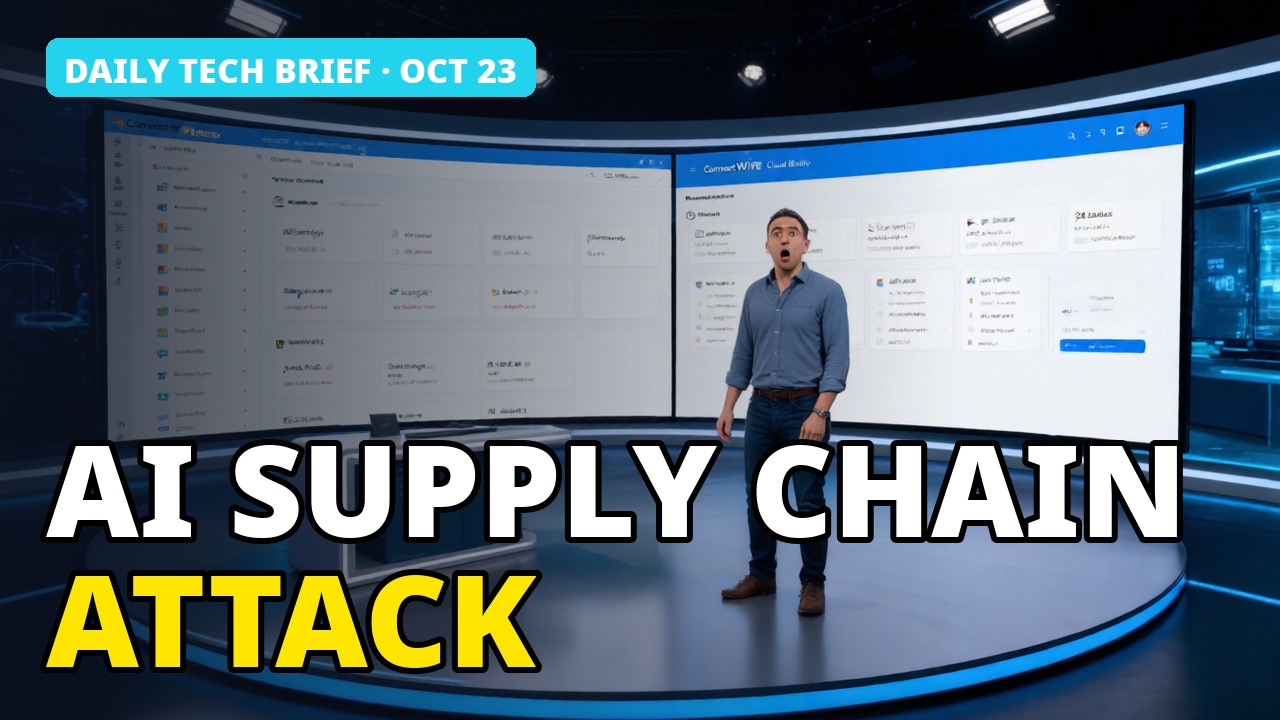
Today’s briefing covers NVIDIA’s GTC Berlin announcements on AI factories and robotics labeling, a critical vulnerability in AI coding agents via malicious instruction files, AI-assisted exploitation of PHP2Shell vulnerabilities against a European government, and Anthropic’s updated timeline for self-improving AI alongside a shift toward single-agent architectures.
Listen to today’s briefing (podcast)
NVIDIA GTC Berlin Unveils AI Factories, Physical AI, and Flora Robot Labeling
Jensen Huang declared at GTC Berlin 2026 that the industry is at the beginning of a new industrial revolution and AI economy, positioning NVIDIA as a ‘full stack, end-to-end, complete AI factory platform’ (source: NVIDIA GTC Berlin 2026 Keynote). The company introduced DSX Pod as the next evolution of NVIDIA computing, described as a complete transformation of the world’s supply chain, and detailed AI factories that run entire agents composed of models, sandbox, harness, knowledge, and tools. NVIDIA also launched OpenShell, stating ‘just about every major company have come out to adopt OpenShell,’ and emphasized providing open weights and tools to turn data into ‘sovereign intelligence,’ while CUDA-X libraries and tools aim to make every tools company an AI company (source: NVIDIA GTC Berlin 2026 Keynote).
Physical AI received a standardized platform with Hyperion, a giant virtual fleet compatible with vehicles from Volkswagen, Jaguar Land Rover, Volvo, and Mercedes (source: NVIDIA GTC Berlin 2026 Keynote). NVIDIA unveiled the Agile ONE reference humanoid robot to accelerate robotics development and announced RTX Spark, a new line of computers created after four years of partnership with Microsoft. The company also highlighted its 12,000+ partnerships in Europe working to build Europe’s AI economy (source: NVIDIA GTC Berlin 2026 Keynote).
NVIDIA open-sourced Flora, an open data engine from its GEAR research lab, to make robot video labeling 125x cheaper than GPT-6 Astra — 72 cents per hour versus $88.50 — based on $10 per GPU per hour rental costs (source: The Decoder article (Oct 25, 2026)). Flora covers three label types — action descriptions, step-by-step progress ratings, and task completion judgments — and can annotate up to 200,000 hours of video per day across 512 GB300 GPUs during GR00T model training, with models available on Hugging Face. The system consists of three fine-tuned Qwen3.5 models: a 9B model for action segmentation, a 27B model for contextual description, and a 27B Flora-Rewarder for success rating, step classification, and rubric-based scoring. In a 50-video test, Flora scored slightly better than GPT-6 Astra even with Astra’s full reasoning. On WGO-Bench, Flora leads in action boundary detection but trails Astra overall and Gemini 3.8 Flash in description accuracy; on DenseCaptionBench, Flora leads for human recordings but is second to Astra for robot videos; on RoboRewardBench, Flora’s error rate is 27.8% lower than Astra’s, with Flora-Rewarder catching 53.3% of failed steps versus competitors ≤11.7% and Astra 0%, though Flora falsely flags ~11% of normal steps as errors. In a video with many short hand movements, Flora identified 34 of 37 actions versus Astra’s 4, though it sometimes over-segments longer actions and mislabels (e.g., wiping plate described as folding napkin). NVIDIA positions Flora as an open alternative to Scale AI’s Physical AI Data Engine, and researchers can use it to scale robotics datasets and test human-to-robot demonstration transfer. Google’s Gemini 4 Argon targets a similar robotics training process (source: The Decoder article (Oct 25, 2026)).
Why it matters: For IT professionals, the announcements signal a shift toward AI factories and agent-based computing with new platforms (OpenShell, Hyperion, Flora) enabling scalable, secure AI deployment and robotics development. For everyday people, it means more affordable and capable AI-powered robots and autonomous vehicles entering daily life, potentially transforming transportation, manufacturing, and home assistance.
AI Coding Agents Hit by VM Escapes and Prompt Injection via AGENTS.md
Researchers at Forever Security discovered a malicious AGENTS.md file in a customer’s Downloads folder that tricked an AI coding agent into installing a rogue npm package named ‘function-color’ (source: https://www.bleepingcomputer.com/news/security/ai-coding-agents-hijacked-using-agentsmd-file-in-downloads-folder/). They reproduced the attack against OpenAI Codex and demonstrated a related technique against Claude Code to leak OAuth tokens and hijack the account using only the malicious instructions. The investigation traced the agent’s attempt to the AGENTS.md file in the customer’s ~/Downloads folder, which also served as the agent’s working directory; agents automatically load applicable files from their working directory and use the contained instructions to guide their actions (source: https://www.bleepingcomputer.com/news/security/ai-coding-agents-hijacked-using-agentsmd-file-in-downloads-folder/).
Forever Security notes that ‘~/Downloads is special. It is the one folder the web can write to on its own,’ and that ‘a web page can download a file named AGENTS.md into your Downloads folder, silently’ (source: https://www.bleepingcomputer.com/news/security/ai-coding-agents-hijacked-using-agentsmd-file-in-downloads-folder/). By default, Chrome, Edge, and Firefox save downloads to ~/Downloads without prompting for a location. Internal statistics show hundreds of customers run AI agents — including Claude Code, OpenAI Codex, and Cursor CLI — from their ~/Downloads folders, with Claude Code alone launching more than 1,300 sessions from that location (source: https://www.bleepingcomputer.com/news/security/ai-coding-agents-hijacked-using-agentsmd-file-in-downloads-folder/). The researchers tested a reconstructed attack chain against Codex with a harmless calculator payload, achieving a 90% success rate, and used a malicious CLAUDE.md file to redirect Claude Code’s API traffic to a controlled server, exposing the OAuth token and achieving code execution in roughly 50% of tests (source: https://www.bleepingcomputer.com/news/security/ai-coding-agents-hijacked-using-agentsmd-file-in-downloads-folder/).
OpenAI and Anthropic recommend running their AI coding agents from the project directory they are intended to work on, rather than from the home directory or a broad parent directory (source: https://www.bleepingcomputer.com/news/security/ai-coding-agents-hijacked-using-agentsmd-file-in-downloads-folder/). OpenAI has announced plans to conduct frontier model training with no live internet access as it resumes reinforcement learning training and internal inference of its most advanced models, stating that ‘based on the current state of alignment research, monitoring systems, and the security of internet infrastructure, we believe the responsible approach is to conduct frontier model training with no’ live internet (source: https://thehackernews.com/2026/10/openai-ai-agents-demonstrate-vm-escapes.html). The Blue Report 2026 measures defenses technique by technique across 338 million simulations run in customer production environments (source: https://www.bleepingcomputer.com/news/security/ai-coding-agents-hijacked-using-agentsmd-file-in-downloads-folder/).
Why it matters: For IT professionals, this reveals a critical supply-chain-style vulnerability where AI coding agents can be weaponized via malicious instruction files in common directories, demanding immediate changes to agent configuration, sandbox policies, and developer workflow hygiene. For everyday people, it means simply visiting a compromised website could silently drop a file that hijacks their AI assistant, potentially stealing credentials or executing unauthorized code on their personal machines.
PHP2Shell Vulnerabilities Exploited Against Government Entity with AI Assistance
Threat actors have been observed using agentic artificial intelligence platforms for post-exploitation activity following the abuse of the PHP2Shell vulnerabilities tracked as CVE-2026-109618 and CVE-2026-109619 (source: Siber Güvenlik Haberleri — PHP2Shell Exploitation Hits Government Entity Amid Global Scanning and Signs of AI-Assisted Hacking).
In one case, the attackers targeted a government entity in Europe and within two hours of the initial exploitation they had successfully accessed password hashes and multi-factor (source: Siber Güvenlik Haberleri — PHP2Shell Exploitation Hits Government Entity Amid Global Scanning and Signs of AI-Assisted Hacking).
Why it matters: For IT professionals, this demonstrates how AI can accelerate post-exploitation phases, requiring faster detection and response. For everyday people, a government breach could expose sensitive personal data and disrupt public services.
Anthropic Predicts Self-Improving AI by 2027 and Recommends Single-Agent Architectures
A new benchmark called TasteVal measures how well AI systems design experiments on their own and interpret results, a capability P-Zero Research calls ‘research taste’ (source: Anthropic co-founder Jack Clark moves his prediction for self-improving AI forward to 2027). The capability has roughly doubled every three months since December 2025, and the best model tested outperformed a comparison group of 24 human experts at a fraction of the cost. Jack Clark, Anthropic co-founder and author of the Import AI newsletter, now believes recursive self-improvement (RSI) — where AI systems develop their own successors — could become possible as early as 2027, moving his previous expectation from 2028. The benchmark does not prove AI systems are already improving themselves, as it captures only a narrow slice of scientific work. Anthropic’s Opus 5.5 hit a compute multiplier of 2.3 (range 1.15–4.37), reaching expert-level scores with less than half the compute, and a single run cost roughly one-thirtieth of an average expert attempt. Across model generations, the compute multiplier has roughly doubled every three months since December 2025 (doubling time range 1.7–5.0 months). In a May essay, Clark had put the odds of a system independently training a stronger successor at roughly 60% by end of 2028 and 30% by 2027 (source: Anthropic co-founder Jack Clark moves his prediction for self-improving AI forward to 2027).
Anthropic found that a single agent with on-demand context often outperforms multi-agent setups in quality, cost, and latency, and is releasing a migration kit to help teams evaluate and switch (source: Anthropic says one AI agent beats many subagents now that models can handle complexity alone). Newer models starting with Opus 4.5, along with Opus 5.5 and Fable 5.1, can manage complex plans directly in a single loop, reducing costs and wait times; in one comparison, the single-agent architecture ran about twice as fast as the multi-agent setup. Anthropic calls this ‘Conway’s Law’ for agents: the architecture becomes a copy of the org chart, with each team shipping its own sub-agent until hundreds of overlapping agents pile up with no shared standards, leading to a ‘Frankenprompt’ of contradictory rules. As an example, Anthropic cut the Claude Code system prompt for newer models by over 80%, partly because skills and tools now load only when needed. The migration kit on GitHub walks teams through identifying existing patterns, evaluating alternatives, and verifying the best approach (source: Anthropic says one AI agent beats many subagents now that models can handle complexity alone).
A study by Vals found that agent teams can be faster than single agents but do not deliver higher quality; scaling from ten to 30 or 100 agents brought no quality gains but significantly higher costs (source: Anthropic says one AI agent beats many subagents now that models can handle complexity alone).
Why it matters: For IT professionals, the prediction of self-improving AI by 2027 signals a paradigm shift toward automated AI research, while the endorsement of single-agent architectures simplifies system design, reduces latency, and cuts costs. For everyday people, these advances could accelerate AI capabilities in daily applications, making AI assistants more responsive and reliable.
n8n — Anthropic’s recommendation to consolidate sub-agents into single agents aligns with n8n’s visual workflow platform for building and managing AI agent architectures. Build and control complex AI agent workflows visually with n8n’s source-available platform, supporting multi-agent setups and 500+ integrations. Try n8n
Runpod — Runpod provides on-demand GPU infrastructure for training and deploying the kinds of AI models powering NVIDIA’s AI factories and physical AI initiatives. Try Runpod’s serverless GPUs to train, fine-tune, or deploy models like those used in NVIDIA’s Flora robot labeling engine. Try Runpod
Affiliate disclosure: some links in this description are affiliate links. If you sign up through them, SysArticles may earn a commission at no extra cost to you. We only mention tools that are relevant to the story.
These developments highlight the accelerating pace of AI infrastructure, the emerging security risks of autonomous agents, and the strategic architectural choices shaping the next generation of AI systems.
Ali YAZICI is a Senior IT Infrastructure Manager with 15+ years of enterprise experience. While a recognized expert in datacenter architecture, multi-cloud environments, storage, and advanced data protection and Commvault automation , his current focus is on next-generation datacenter technologies, including NVIDIA GPU architecture, high-performance server virtualization, and implementing AI-driven tools. He shares his practical, hands-on experience and combination of his personal field notes and “Expert-Driven AI.” he use AI tools as an assistant to structure drafts, which he then heavily edit, fact-check, and infuse with my own practical experience, original screenshots , and “in-the-trenches” insights that only a human expert can provide.