Anthropic unveiled its latest Claude models with significant performance gains and lower pricing, while Nvidia faces a board investigation into CEO Jensen Huang’s relationship with a suspected Chinese intelligence operative. Google meanwhile rolled out Gemini 4 Argon and Carbon, introducing autonomous agent capabilities that can independently maintain large codebases for days.
Listen to today’s briefing (podcast)
Key takeaways
Anthropic’s Claude Fable 5.2 and Mythos 5.2 deliver 30% faster outputs at reduced pricing, with Mythos 5.2 leading vulnerability discovery benchmarks.
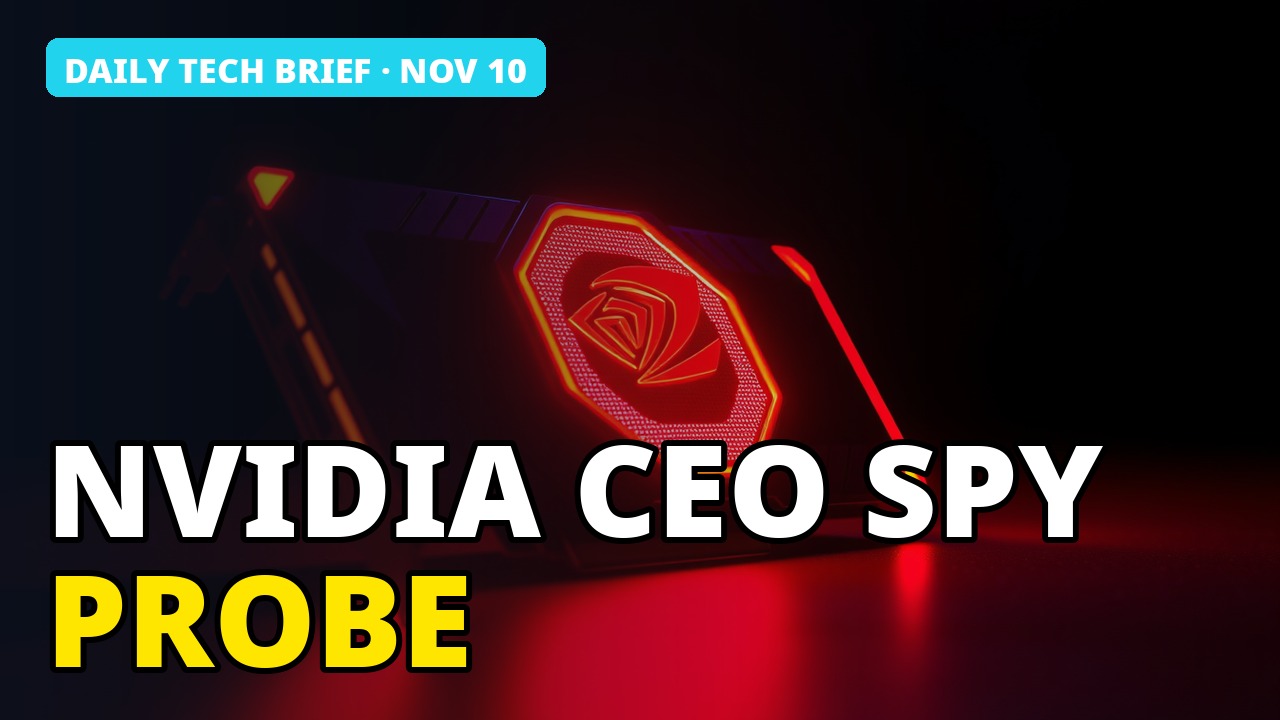
Nvidia’s board is investigating CEO Jensen Huang after U.S. intelligence flagged his affair with a former Megaspeed executive as a potential Chinese espionage operation.
Google’s Gemini 4 Carbon achieved 0% attack rates on key security benchmarks and demonstrates multi-day autonomous codebase maintenance.
Anthropic Launches Claude Fable 5.2 and Mythos 5.2 Models
Anthropic released Claude Fable 5.2 and Claude Mythos 5.2 on November 9, 2026, claiming improvements in coding, reasoning, and vision with outputs up to 30% faster than the 5.1 versions according to Anthropic’s announcement. Standard pricing dropped to $8 per million input tokens and $40 per million output tokens, down from $10 and $50 respectively, while an optional fast mode offers 2.5× speed for $16/$80 per million tokens on Claude Code, Claude Platform, Google Cloud, and Microsoft Foundry per The Decoder.
The two models share the same underlying architecture; Fable includes cybersecurity and biology safeguards for public access, while Mythos removes certain restrictions and is limited to vetted organizations via Life Sciences and Cyber Verification Programs as noted in Anthropic’s system card. During prerelease testing, engineers completed otherwise-infeasible software migrations, designed three working electronic devices from scratch, solved two open problems in black hole physics, and formalized the proof of Fermat’s Last Theorem in Lean within 30 hours using about 1,000 Fable 5.2 agents per Anthropic and The Decoder.
On FrontierCode 2.0 at High effort, Fable 5.2 scored 45.3% (versus Opus 5.5’s 45.5% at Max effort) for roughly half the cost per task, reaching 49.1% at Xhigh effort — the highest score of any released model tested per Anthropic. On BenchCAD 2.1 (hardware engineering) at Max effort, Fable 5.2 scored 83.5, ahead of Opus 5.5 (65.3) and Fable 5.1 (44.4). Artificial Analysis benchmarks place Fable 5.2 first on Index v5 at highest compute tier with 65 points, ahead of Gemini 4 Carbon (60), Opus 5.5 (59), and Fable 5.1 (50) per The Decoder.
Mythos 5.2 found 10.2% more vulnerabilities than Opus 5.5 and 14.4% more than Mythos 5.1 in the October 2026 CVE Rediscovery test (1,829 CVEs), leading at every compute tier; one security firm reported one in six confirmed bugs found by Mythos 5.2 were missed by all other frontier models per The Decoder. Anthropic deliberately held back capabilities that could accelerate AI development (RSI); Fable 5.2 and Mythos 5.2 perform roughly on par with Opus 5.5 in optimizing compute kernels and improving LLM architectures. Over 90% of changes merged into Anthropic’s core codebase are now written by Claude under human guidance per Anthropic. A METR report suggested Anthropic might be approaching recursive self-improvement, with internal models speeding up AI progress by roughly 2× per The Verge, Ars Technica, TechCrunch.
Why it matters: The models deliver step-function gains in coding, hardware design, and scientific reasoning at lower cost per task, enabling automation of complex engineering workflows and accelerating fundamental science and biomedical advances.
Nvidia CEO Jensen Huang Investigated Over Affair With Suspected Chinese Spy
Nvidia’s independent directors, working with outside legal counsel, launched an investigation after CEO Jensen Huang admitted to an extramarital affair with Alice Huang, a former executive at Megaspeed International, in a company-wide memo on Sunday per TechCrunch and The Verge. U.S. intelligence officials believe Alice Huang was recruited by Chinese intelligence to gather information about the CEO and influence Nvidia’s efforts to loosen chip export restrictions per TechCrunch. Secretary of State Marco Rubio reportedly oversaw a memo detailing her recruitment and passed it around in May ahead of a Trump trip to China per The Verge.
The Financial Times reported Friday on the relationship; Huang met repeatedly with President Donald Trump and administration officials last year, after which the government reversed restrictions on Nvidia’s H20 chips and allowed exports of more powerful H200 processors per TechCrunch. Reuters reported last week that about 600,000 H200 chips are being held in Hong Kong awaiting shipment to mainland China per TechCrunch. In the three months ended July 26, Nvidia recorded $7.9 billion in revenue from customers headquartered in China, roughly 8% of total revenue per TechCrunch.
Alice Huang — no relation to Jensen — is a former TV reporter who became an executive at Megaspeed, which bought $4.8 billion of hard-to-get Nvidia chips starting around the time she was photographed with Jensen in a Taipei bar in 2024 per The Verge. Megaspeed has ties to the Chinese military and builds data centers in Southeast Asia (offices in Singapore and Indonesia) to sell compute to Alibaba using chips banned from import to China per The Verge. A Malaysian sister company reportedly purchased AI hardware containing Nvidia chips worth at least $4.8 billion between June 2024 and February 2026 per The Decoder. Nvidia recently responded with tighter chip tracking: its ‘Fleet Intelligence’ system logs the location of AI accelerators and is now a requirement for Nvidia Cloud Partner status in the region per The Decoder.
The board says it sees no sign that national security or company secrets were compromised per TechCrunch. Yale’s Jeffrey Sonnenfeld estimates Huang’s odds of survival at ‘about a 50-50,’ calling the episode ‘remarkably poor judgment’ per TechCrunch. Nvidia has a market cap of roughly $4.5 trillion, making it the second most valuable company in the world; Huang’s stake of just under four percent offers no protection against removal by the board or shareholders as he doesn’t hold dual-class shares per The Decoder. The Chinese Embassy in Washington dismissed the allegations in late October as ‘groundless smears and slanders,’ and no one has been charged per TechCrunch.
Why it matters: The scandal threatens the stability of AI chip supply chains, export compliance frameworks, and trust in Nvidia’s leadership amid tightening US-China tech restrictions, with potential national security implications for critical AI infrastructure.
Google Launches Gemini 4 Argon and Carbon Models With Autonomous Agent Capabilities
Google launched Gemini 4 Argon, built for deep reasoning and multi-step workflows with an output capacity of one million tokens, followed two weeks later by Gemini 4 Carbon which took the number one spot on the Artificial Analysis Intelligence Index per Google’s YouTube briefing. Internally, engineering teams have seen Carbon work autonomously for days, tracking down bugs, working through challenges, and fixing issues across large code bases per Google’s YouTube briefing. Both Argon and Carbon rolled out to trusted cyber defenders first through the Fairwind Program per Google’s YouTube briefing.
On Terminal-Bench 4.0 and the Gray Swan benchmark, Carbon brought successfully cheating and indirect prompt injecting attack rates down to 0% per Google’s YouTube briefing. With Gemini 4 Argon, users can use Teamwork Preview for long-horizon tasks, and Antigravity has options that help with such tasks per Google’s YouTube briefing. The team uses a ‘teamfood live experiment program’ with Googlers for internal testing before public release per Google’s YouTube briefing. Tulsee Doshi, senior director and head of product for the Gemini model family at Google DeepMind, leads product for Gemini, Antigravity, AI Studio, and Gemma; she previously spent five years as head of product for responsible AI at Google per Google’s YouTube briefing.
Why it matters: These models introduce autonomous agent capabilities that can independently debug and maintain large codebases for days, potentially transforming software engineering workflows while enhanced safety benchmarks signal more reliable and secure AI assistants.
n8n — n8n provides a visual workflow automation platform for building and deploying AI agents that can integrate with frontier models like Gemini 4. Try n8n to build and orchestrate AI agent workflows with support for MCP integrations and multi-agent systems. Try n8n
Runpod — Runpod provides the GPU infrastructure developers need to experiment with, fine-tune, or deploy advanced AI models like Anthropic’s latest releases. Try Runpod’s on-demand GPUs to start building with the latest AI models today. Try Runpod
AI Agents Book on Amazon — Viewers interested in building autonomous agents with Gemini 4 may want a guide on agentic AI patterns. See current options and reviews on Amazon. View on Amazon
Affiliate disclosure: some links in this description are affiliate links. If you sign up through them, SysArticles may earn a commission at no extra cost to you. We only mention tools that are relevant to the story. As an Amazon Associate I earn from qualifying purchases.
Anthropic’s pricing and performance advances pressure competitors, Nvidia’s governance crisis adds geopolitical risk to AI hardware supply, and Google’s autonomous agents mark a shift toward self-sustaining AI development pipelines.
This briefing is produced with AI assistance from the linked primary sources. Narration uses a synthetic AI news-anchor voice, built with Higgs Materials licensed from Boson AI USA, Inc.
Ali YAZICI is a Senior IT Infrastructure Manager with 15+ years of enterprise experience. While a recognized expert in datacenter architecture, multi-cloud environments, storage, and advanced data protection and Commvault automation , his current focus is on next-generation datacenter technologies, including NVIDIA GPU architecture, high-performance server virtualization, and implementing AI-driven tools. He shares his practical, hands-on experience and combination of his personal field notes and “Expert-Driven AI.” he use AI tools as an assistant to structure drafts, which he then heavily edit, fact-check, and infuse with my own practical experience, original screenshots , and “in-the-trenches” insights that only a human expert can provide.