Today’s briefing covers a critical performance bottleneck on NVIDIA’s new RTX Spark laptops, Google’s latest multimodal AI agent capabilities, and a historic revenue milestone for AMD in the data center. These developments highlight how hardware-software integration, real-time AI interaction, and shifting processor dynamics are shaping enterprise infrastructure.
Listen to today’s briefing (podcast)
Key takeaways
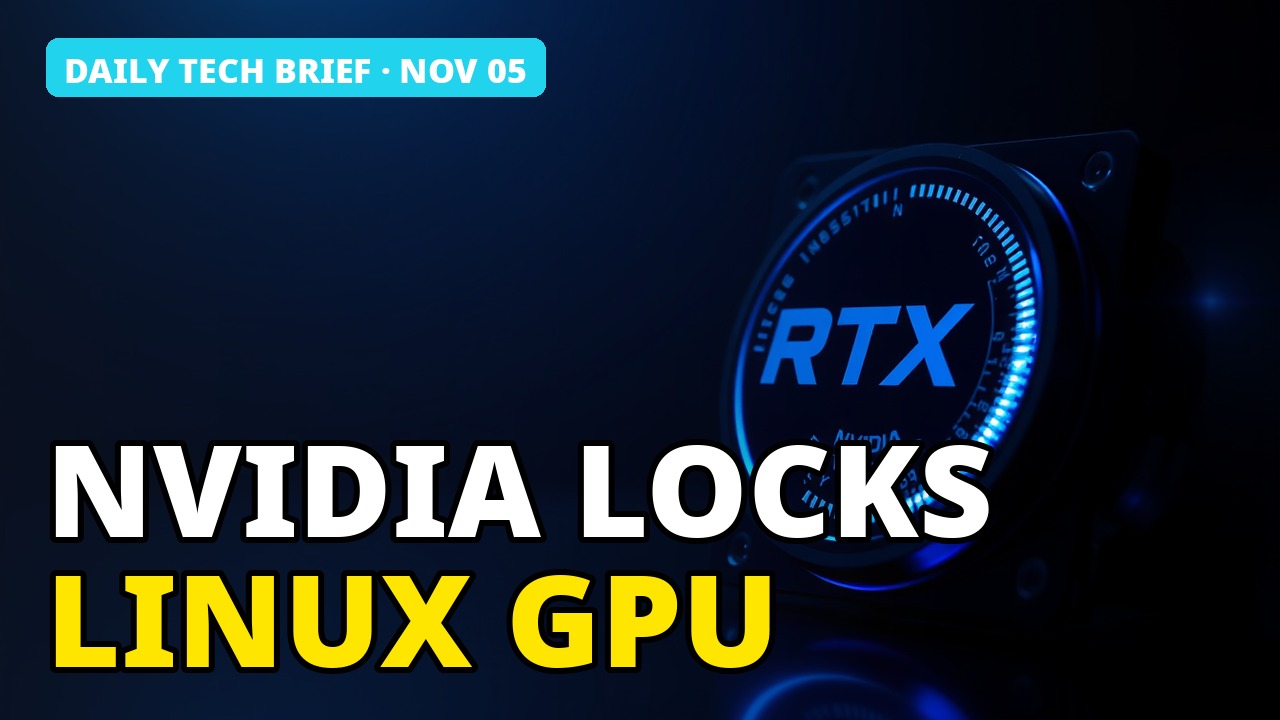
NVIDIA RTX Spark laptops suffer a 5x inference slowdown on Linux due to encrypted power-management firmware that only Windows can decode.
Google’s Gemini Live API now enables real-time vision alongside voice in a single session, with snapshot and stream patterns for token-efficient multimodal agents.
AMD projects Q4 2026 revenue of ~$17 billion, surpassing Intel for the first time, driven by 97% year-over-year data center growth from EPYC and Instinct MI455X accelerators.
NVIDIA RTX Spark Encrypted Firmware Slows Linux Inference
Linux runs on RTX Spark laptops like the MSI Prestige N16 Flip AI Plus using NVIDIA’s open kernel driver, but GPU clocks lock to roughly 780 MHz when plugged in instead of the 2 GHz-plus seen on Windows. This drops inference on a 120-billion-parameter model from about 65 tokens per second to just 14 tokens per second, a fivefold slowdown confirmed across multiple benchmarks. The root cause is an encrypted power-management firmware table that the Windows driver can decrypt but Linux currently cannot, as reported by Hacker News (mindstudio.ai blog).
Installation hurdles compound the issue: an Arch-based Omarchy build flickered on boot, while Debian required a USB Ethernet dongle and missed keyboard, touchpad, and GPU drivers initially. The firmware reserves 96 GB of the 128 GB unified memory for GPU use, a split adjustable only from Windows; reducing that reservation to 4 GB freed 120 GB for Linux and enabled a full 4K 120 Hz desktop with CUDA acceleration. Unplugged, Linux matches Windows performance (61–67 tokens per second), confirming the throttle is power-source dependent.
Disabling the NVIDIA Platform Controllers and Framework component in Windows Device Manager reproduces the exact Linux slowdown, proving the controller manages the shared CPU-GPU power budget via the encrypted table. Extracting the decryption key from the Windows driver was discussed but deemed a fragile single-machine hack. A proper fix requires NVIDIA to ship equivalent power-management logic in its Linux driver; until then, WSL works because it inherits the Windows driver stack and full GPU boost behavior.
Why it matters: IT teams deploying AI workloads on RTX Spark laptops must plan for Windows or WSL to achieve full GPU performance, as native Linux inference runs at roughly 35% speed when plugged in.
Google Gemini Live API Adds Real-Time Vision for AI Agents
Google’s Gemini Live API now accepts image blobs (bytes plus MIME type) within the same live session that handles audio, enabling agents to see and speak simultaneously. Live video is not an MP4 stream but a sequence of still frames sent over time, and the underlying SDK surfaces this capability for any agent built on the Gemini app APIs, according to Google Cloud Press Corner.
Two frame-delivery patterns are recommended: snapshot for deliberate, static scenes (a document, an outfit, a browser page after a click) and stream for continuously changing environments (a person moving through a room). Every frame consumes context and tokens, so streaming a browser page constantly can interrupt the live audio session; snapshots after user actions are the safer default. Voice and vision signals combine in one session, letting the model resolve references like “that button” while seeing the screen.
An advanced pattern uses a separate lightweight vision model as a “Skywatcher” that scans frames for specific triggers (hazards, gestures, state changes) so the main agent doesn’t process every frame. This completes the bidirectional live model agent series that progressed from live voice, to tools, browser control, memory, and now real-time vision.
Why it matters: Developers can now build multimodal agents that fuse real-time voice and vision in a single session, choosing snapshot or stream patterns to balance awareness with token budget and session stability.
AMD Projects Q4 Revenue Ahead of Intel for First Time
AMD expects Q4 2026 revenue of approximately $17 billion (±3%), which would put it ahead of Intel quarterly revenue for the first time in history. Q3 2026 revenue reached $13.377 billion, up 45% year-over-year, with the Data Center segment hitting a record $8.55 billion — a 97% year-over-year surge and 27% sequential growth. Data Center operating income jumped 168% to $2.88 billion, expanding the operating margin from 25% to 34%, as reported by Tom’s Hardware.
Growth is fueled by strong EPYC processor demand and the launch of Instinct MI455X AI accelerators powering Helios rack-scale systems. Anthropic, Meta, Microsoft, OpenAI, and Oracle Cloud Infrastructure are already running workloads on their first Helios deployments. AMD projects Data Center revenue to reach approximately $12.8 billion in Q4, driven by the MI455X and Helios ramp. Lisa Su stated the company now expects server revenue to double year-over-year in 2027 and data center to exceed 80% of total revenue.
Meanwhile, the Client and Gaming segment declined 8% year-over-year to $3.722 billion and is projected to contract more than 20% sequentially in Q4 as higher memory prices weaken PC demand. The Embedded segment grew 29% year-over-year to $1.11 billion with operating income up 60% to $453 million. Intel’s data center revenue was $7.3 billion, up 78% year-over-year, but AMD’s 97% growth rate widened the gap, per ServeTheHome.
Why it matters: AMD’s projected overtaking of Intel in quarterly revenue marks a historic shift in data center processor dominance, influencing procurement strategies and accelerating AI infrastructure deployment.
Runpod — Cloud GPU platforms bypass local firmware constraints by managing infrastructure remotely. Try Runpod’s on-demand GPUs for inference workloads without managing local hardware. Try Runpod
USB Webcam on Amazon — The demo processes live camera frames, so a USB webcam lets you test the Gemini Live API yourself. See current options and reviews on Amazon. View on Amazon
Affiliate disclosure: some links in this description are affiliate links. If you sign up through them, SysArticles may earn a commission at no extra cost to you. We only mention tools that are relevant to the story. As an Amazon Associate I earn from qualifying purchases.
The convergence of hardware-level firmware constraints, real-time multimodal APIs, and a reshaping server CPU landscape underscores how quickly the AI infrastructure stack is evolving. Stay tuned for tomorrow’s briefing.
Ali YAZICI is a Senior IT Infrastructure Manager with 15+ years of enterprise experience. While a recognized expert in datacenter architecture, multi-cloud environments, storage, and advanced data protection and Commvault automation , his current focus is on next-generation datacenter technologies, including NVIDIA GPU architecture, high-performance server virtualization, and implementing AI-driven tools. He shares his practical, hands-on experience and combination of his personal field notes and “Expert-Driven AI.” he use AI tools as an assistant to structure drafts, which he then heavily edit, fact-check, and infuse with my own practical experience, original screenshots , and “in-the-trenches” insights that only a human expert can provide.