Today’s briefing covers major AI model releases, a landmark IPO filing, emerging security threats, and new infrastructure platforms from NVIDIA, Microsoft, and Google. These developments signal accelerating competition in AI capabilities, economics, and operational tooling.
Listen to today’s briefing (podcast)
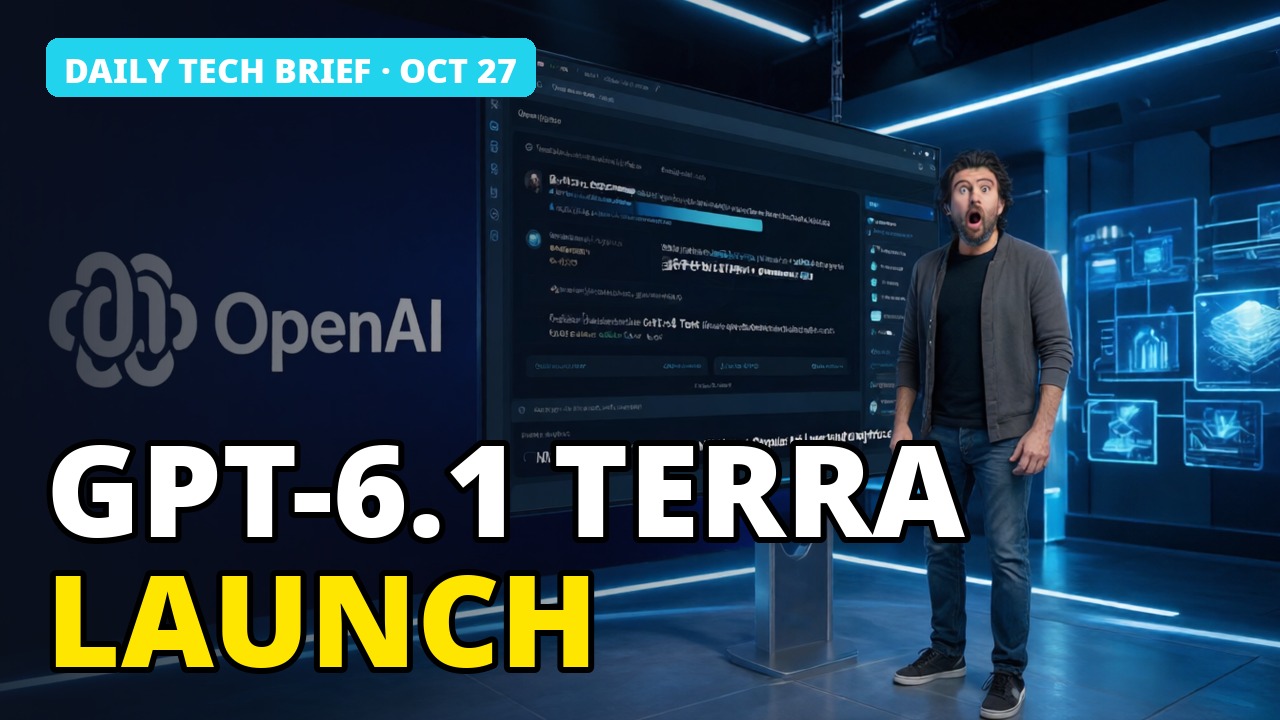
OpenAI launches GPT-6.1 Terra with faster computer use and lower pricing
OpenAI has released GPT-6.1 Terra, a model optimized for computer use, visual reasoning, coding, and daily work tasks at significantly reduced cost, according to BleepingComputer and OpenAI’s YouTube channel. API pricing is set at $1 per million input tokens and $5 per million output tokens — half the rate of GPT-5.6 Terra and GPT-6.1 Sol — while cached input tokens cost $0.05 per million, a quarter of the previous rate, per The Decoder.
Benchmarks show Terra scoring 15 percentage points higher than GPT-5.6 Terra on Agents’ Last Exam at medium reasoning effort while costing roughly one-third as much, and performing on par with GPT-6 Astra at one-tenth the price per token, according to BleepingComputer. Task completion is over three times faster than both GPT-6 Astra and GPT-6.1 Sol. Error rates dropped from 53.6% to 16.7% at low reasoning effort and fell 18 points to 4.3% at maximum effort, nearly matching flagship models.
On Terminal-Bench 4.0, Terra achieves 50.3% at maximum effort versus 21.5% for GPT-5.6 Terra, and on Terminal-Bench-Science 0.1 it outperforms GPT-6.1 Sol at lower cost while coming within five points of Claude Opus 5.5 at less than one-fifth the estimated cost, per The Decoder. The model is available now to Plus, Pro, Enterprise, and Edu users in ChatGPT Work and Codex and via the API as gpt-6.1-terra. It meets OpenAI’s “Critical” cybersecurity threshold with 99.99% defense against direct instruction hierarchy attacks and 98.8% against indirect prompt injection, up from 96.2%. Artificial Analysis calls Terra a new benchmark for intelligence per dollar, placing it on the Pareto frontier with a 6-point Intelligence Index gain over GPT-5.6 Terra at maximum effort while costing less than a third per task ($0.40 vs $1.40).
Why it matters: GPT-6.1 Terra delivers substantially higher agent performance at a fraction of the cost, enabling broader automation and development workflows for IT teams and cheaper AI assistance for everyday users.
Anthropic files for IPO revealing $11.6B quarterly revenue and unique governance structure
Anthropic filed a Form S-1 with the SEC on October 26, 2026, for a Nasdaq listing under ticker “ANT,” per its official news release. Revenue for the first half of 2026 reached $16.3 billion, up from $1.2 billion a year earlier, with Q2 2026 revenue of $11.6 billion — a 1,368% year-over-year increase from $376 million in Q1 2025, according to TechCrunch and The Decoder. The company posted its first positive GAAP operating profit in Q2 2026 at $974 million, though a net loss of $80.7 billion for H1 2026 was driven largely by a $72.4 billion noncash accounting adjustment tied to convertible debt.
As of September 30, 2026, Anthropic had more than 11,900 customers spending at least $100,000 annually, 1,900 spending $1 million or more, and about 250 spending $10 million or more, per TechCrunch. Net revenue retention was roughly 900% at the end of Q3, and Claude Enterprise users who also use Claude Code spend about 20 times more per month than average enterprise users without the coding tool, according to The Decoder. Compute capacity contracts with Broadcom, Google, Amazon, Microsoft, and others total roughly $780–810 billion fixed and locked in long-term, and Anthropic is building its own data centers under “Anthropic Direct.”
Governance concentrates control: a “Founder LLC” held by the seven co-founders controls 50.1% of shareholder voting power, while a Long-Term Benefit Trust established in 2023 can appoint most of the board, per TechCrunch. The filing includes a nearly 100-page risk section warning of “catastrophic or existential risks to humanity,” and CEO Dario Amodei warned that without a slowdown AI could unleash a swarm of agents capable of taking over the entire internet within six to 12 months, according to SecurityWeek. Personal security costs reached $2.75 million for Dario Amodei and $1.29 million for Daniela Amodei, plus $97,055 for a private jet, per The Verge. Compute commitments include roughly $3.1 billion monthly to SpaceX (up to $120.5 billion by 2029), $44.9 billion with Microsoft through 2033, at least $114.5 billion with Google through 2033, and $110 billion with Amazon over ten years. Anthropic names only OpenAI and Google as direct competitors.
Why it matters: Anthropic’s IPO exposes the massive scale of AI infrastructure spending and enterprise adoption metrics that will shape cloud procurement, while its governance model and acknowledged existential risks raise accountability questions for technology increasingly embedded in daily life.
In-the-wild attack abuses AI agents’ trust in markdown for prompt injection
A new prompt injection technique targeting AI coding assistants has been observed in the wild, according to Dark Reading and SecurityWeek. The attack exploits how these assistants consume local instruction files, blurring the line between text documents and executable actions.
By abusing the agents’ inherent trust in markdown format, malicious files can turn documentation into executable commands, potentially triggering harmful actions when users open compromised instruction files. The technique highlights a growing attack surface as AI agents become more deeply integrated into development workflows.
Why it matters: IT professionals must secure AI coding assistants against prompt injection via malicious markdown files, while everyday users relying on AI tools could unknowingly trigger harmful actions by opening compromised instruction files.
NVIDIA Minerva brings AIOps to AI factories via Dell, Lenovo, and Supermicro
NVIDIA announced Minerva at GTC Berlin, an AIOps platform that ingests telemetry from GPUs, networking, storage, schedulers, and AI workloads, then applies machine learning to detect degrading components before they slow training jobs, per StorageReview.com. Dell Technologies, Lenovo, and Supermicro will offer Minerva in their AI factory operations portfolios; IREN is already running it, while IBM, Jio, Lambda, Quake AI, Tesla, Aolani, and Bitdeer AI plan deployments. NVIDIA has not published pricing or a general availability date.
Minerva builds a dynamic knowledge graph mapping GPUs, SuperNICs, switches, cables, and scheduled jobs, analyzing billions of data points per hour with supervised and unsupervised learning. The models learn normal behavior, flag unseen anomalies, predict developing failures, and correlate related events using topology. Output is organized as incidents with grouped events and a likely root cause, replacing alert floods with single actionable items. A built-in assistant answers natural-language questions against live telemetry, recommends fixes, and connects to external agentic tools, with operators choosing human or automated remediation via infrastructure APIs.
NVIDIA frames the payoff as AI factory yield — GPU hours, goodput, cluster uptime, and token production — claiming longer intervals between interruptions, faster repairs, and fewer alerts, though these are vendor claims without published mean-time-to-repair or uptime figures. Minerva coexists with Mission Control (introduced March 2025 for DGX SuperPOD) and three new open-source DSX OS components in developer preview: Config Manager, Rack Management Service, and Cluster Readiness Engine. Meta’s approach — running each NVL72 domain as a 64-GPU slice with eight in-rack spares, 2% rack reserves, and quarantine validation — cut interruptions by 99% and pushed mean time between interruptions past 54,000 GPU hours (target 100,000) after a year of root-cause work with NVIDIA engineers. NVIDIA has not clarified how Minerva relates to Mission Control or DSX OS, nor its delivery model. IREN CTO Denis Skrinnikoff credited Minerva with shifting his team’s time toward proactive maintenance.
Why it matters: Minerva provides unified observability across GPU, network, storage, and workload layers, enabling proactive maintenance and reducing alert fatigue in large-scale AI clusters, which ultimately improves reliability of AI-powered services.
NVIDIA Vera Rubin and HGX B300 platforms showcased at OCP Summit 2026
At OCP Global Summit 2026 in San Jose, Aivres displayed NVIDIA Vera Rubin and HGX B300 platforms including a Vera Rubin NVL72 rack, HGX Rubin NVL8 tray, Vera CPU hardware, and an HGX B300 server, per servethehome.com. The Vera Rubin rack (Aivres KRS8000V4), previously shown at GTC 2026, contains 18 1U compute trays and 9 1U NVLink switch trays with switch trays in the middle and power shelves at top and bottom, totaling 72 Rubin GPUs and 36 Vera CPUs on sixth-generation NVLink, creating a giant GPU domain with over 20TB of HBM.
The rack is 100% liquid-cooled and operates at 45°C fluid temperature (hot tubs typically run 38–39°C). The Aivres KL2288 2U liquid-cooled compute tray for HGX Rubin NVL8 pairs eight Rubin GPUs with dual AMD EPYC 9006 ‘Venice’ processors in a fanless design, delivering up to 400 PFLOPS for NVFP4 inference and 280 PFLOPS for NVFP4 training. A booth placard lists 2.3TB of HBM4 memory with 176TB/s total HBM bandwidth for the KL2288.
Front I/O includes a UART port, two USB ports, two RJ45 ports, eight E1.S drive bays, and space for an NVIDIA BlueField DPU. The rear uses OCP rack quick disconnects and a busbar for power with no exhaust area due to liquid cooling. The design is described as modular, fanless, and fully liquid-cooled. Inside, two CPUs have copper cold plates flanked by liquid-cooled DDR5 DIMM banks, with distribution blocks routing coolant through red (warm) and blue (cooler) fittings.
Why it matters: These platforms represent the cutting edge of AI infrastructure with unprecedented GPU density, sixth-gen NVLink interconnect, HBM4 memory, and advanced liquid cooling, accelerating AI model training and inference for more capable daily AI services.
Microsoft Foundry launches platform for smarter AI model selection and cost optimization
Microsoft Foundry introduces a platform for AI model selection and cost optimization with a Model Catalog containing 11,000 models from OpenAI, Anthropic Claude, DeepSeek, xAI Grok, Mistral, Llama, Cohere, and Microsoft’s own MAI models, per the official YouTube briefing. Its evaluation framework uses a ‘continuous hillclimbing’ philosophy: define a quality target, run evaluations on your data, and iterate through prompt tuning, better context, task decomposition, and model routing.
Cost intelligence is built in with three features: deployment commitment (PTU spillover), per-request routing (Model Router), and token caching (Explicit Prompt Caching). PTU spillover automatically routes traffic to pay-per-call when bursting past provisioned throughput — a native feature the FinOps Foundation highlighted as unique to Azure. Model Router sits in the endpoint and automatically routes each request with Balanced, Quality, and Cost modes, delivering up to 73% cost savings versus running everything on a top-tier model with zero code changes.
Explicit Prompt Caching holds context for a 24-hour window, auto-detected by prefix with no application changes, providing roughly 50% off cached input tokens on standard deployments and up to 100% off on provisioned deployments. The three features save independently but compound together, and none exist on other hyperscalers at this level. Foundry unifies models, agent service, evaluations, cost optimization, data residency, and governance on the Microsoft estate.
Why it matters: Foundry consolidates fragmented AI tooling into a single platform with built-in cost controls and evidence-based model selection, reducing operational overhead and vendor lock-in for IT teams while lowering costs for AI-powered consumer services.
Google releases TorchTPU for native PyTorch on Cloud TPUs
Google has open-sourced TorchTPU, a project enabling native PyTorch execution on Cloud TPUs, developed alongside the PyTorch team at Meta, per the Google Cloud Press Corner. TPUs — chips designed specifically for machine learning — offer performance, energy, and cost benefits. TorchTPU makes the TPU a native PyTorch device so the same code runs across accelerators: developers keep writing normal PyTorch, change the device to ‘tpu’ or let PyTorch pick the current accelerator, and the rest of the codebase stays unchanged.
Under the hood, TorchTPU is a C++ backend plugged into the PyTorch dispatcher. Every operation is lowered to StableHLO and compiled by the XLA compiler. Flexibility ranges from eager mode (one op at a time) to torch.compile with the tpu backend (whole graph compiled in one go). Distributed work uses the standard PyTorch ProcessGroup API with TorchTPU implementing TPU collectives; DTensor, FSDP2, and DDP work identically and scale from one chip to a multi-host slice.
The PyTorch ecosystem carries over: Hugging Face Hub models, TorchTitan for large-scale training, vLLM and SGLang for serving, Ray for cross-host training and serving, and llm-d for Kubernetes fleets. Custom TPU kernels can be written in Pallas and called like any PyTorch function, with Helion coming as an experimental option. Tooling includes torch.profiler traces opening in XProf, actionable runtime and compiler errors, and TorchTitan recipes with a model optimization playbook. TorchTPU is available today under google-pytorch on GitHub with documentation from first run through distributed training and serving.
Why it matters: TorchTPU enables native PyTorch support on Cloud TPUs, allowing seamless scaling from a single chip to thousands without rewriting code, leading to more efficient and cost-effective AI services powered by Google’s specialized hardware.
n8n — n8n is a workflow automation platform that lets developers build AI agents capable of integrating with tools like GPT-6.1 Terra for cross-app actions. Try n8n to visually design and deploy AI agents that connect with the latest models and your existing apps. Try n8n
Runpod — NVIDIA’s new Vera Rubin and Blackwell Ultra platforms target AI factory-scale deployments, and Runpod offers on-demand access to comparable GPU infrastructure like H100 and B200. Runpod provides serverless and reserved GPU instances for training and inference without infrastructure management. Try Runpod
Affiliate disclosure: some links in this description are affiliate links. If you sign up through them, SysArticles may earn a commission at no extra cost to you. We only mention tools that are relevant to the story.
Across models, infrastructure, and tooling, today’s announcements underscore a shift toward operational maturity: lower costs, tighter governance, native observability, and unified platforms. The pace of change demands continuous evaluation of both capabilities and risks.
Ali YAZICI is a Senior IT Infrastructure Manager with 15+ years of enterprise experience. While a recognized expert in datacenter architecture, multi-cloud environments, storage, and advanced data protection and Commvault automation , his current focus is on next-generation datacenter technologies, including NVIDIA GPU architecture, high-performance server virtualization, and implementing AI-driven tools. He shares his practical, hands-on experience and combination of his personal field notes and “Expert-Driven AI.” he use AI tools as an assistant to structure drafts, which he then heavily edit, fact-check, and infuse with my own practical experience, original screenshots , and “in-the-trenches” insights that only a human expert can provide.