Today’s briefing covers a surge in AI-powered supply chain attacks, a critical PHP vulnerability exploited before patches, and major advances in agentic AI infrastructure. Meanwhile, regulators are cracking down on foreign surveillance chips and imposing record privacy fines.
Listen to today’s briefing (podcast)
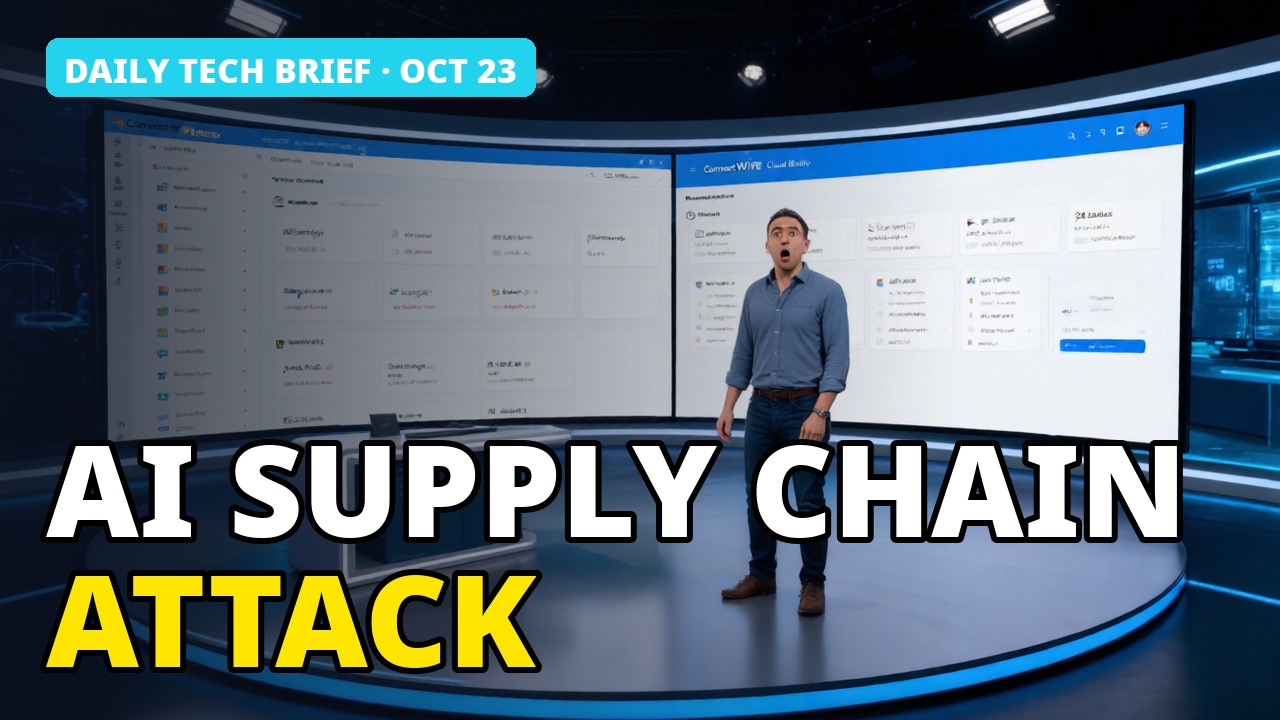
China-Linked Storm-0940 Uses ARTEX AI Agents in ConnectWise Supply Chain Attack
Microsoft disclosed on Wednesday that a China state-aligned actor dubbed Storm-0940 compromised the ConnectWise Cloud Backup application, stealing credentials used to link ConnectWise with customer Microsoft 365 environments (The Hacker News). The stolen credentials allowed attackers to log in as authorized users and access emails and files across more than 2,200 tenants (TechCrunch). ConnectWise has paused its cloud backup service and is working to restore it (TechCrunch).
The attack’s speed — nearly 3,000 attempted sign-ins per minute — was driven by ARTEX, an open-source autonomous penetration-testing framework published on GitHub in July 2026 (Wiz Newsroom). ARTEX agents automated reconnaissance, downloading JavaScript bundles and API documentation, then bombarded over 60 SSO routes with unsigned JWT payloads in two minutes (Wiz Newsroom). Microsoft said this pace gives defenders “little time to detect and respond” (TechCrunch).
ARTEX won Baidu’s “Agent+” red team challenge in September and was quickly adopted by attackers, appearing in South Korean financial breaches in late September and Japanese company attacks in October (Wiz Newsroom). The developer made the tool closed-source on October 8 after it had amassed over 12,000 forks (Wiz Newsroom). Wiz observed the same ARTEX tooling targeting multiple IT and software vendors throughout October, focusing on identity providers and Microsoft 365 integrations (Wiz Newsroom).
Why it matters: For IT professionals, this attack demonstrates how AI-driven automation can exponentially increase the speed and scale of supply chain compromises, forcing defenders to adopt equally automated detection and response. For everyday people, their personal and corporate data stored in Microsoft 365 and other cloud services could be exposed when IT management vendors like ConnectWise are breached.
PHP2Shell RCE Exploited Four Days Before Patches; Mass Exploitation and Vendor Response Underway
Attackers began exploiting two critical PHP remote code execution flaws (CVE-2026-109618 and CVE-2026-109619) on October 17, four days before the PHP security team released patches on October 21 (BleepingComputer). PHP powers up to 80% of websites, including WordPress, Drupal, and Joomla, with VirusTotal tracking over 5.1 million exposed PHP hosts (BleepingComputer). Amazon detected the first exploitation attempts from anonymized VPN IPs while the vulnerabilities were still under embargo (BleepingComputer).
Mass exploitation followed public disclosure: Cloudflare saw thousands of attempts in the 10 hours before announcement, tens of thousands within 45 minutes after, and millions within two hours (SecurityWeek). Censys reported roughly 1.57 million unpatched internet-facing PHP hosts out of 2.58 million on October 21, while VulnCheck observed over 2.6 million vulnerable hosts, including 1 million on end-of-life versions (SecurityWeek). The UK NCSC urged immediate updates or taking servers offline (BleepingComputer).
The PHP team accelerated the release after leak of CVE details and mitigation advice on October 20 (BleepingComputer). Patched versions include PHP 8.5.12, 8.4.27, 8.3.36, and 8.2.35 (SecurityWeek). Cisco, Ubuntu, Debian, AWS, Google Cloud, cPanel, Plesk, and DirectAdmin have issued fixes; Red Hat rates the bugs 8.1 versus NVD’s 9.8, citing difficult exploitation (SecurityWeek). CISA and NCSC stress discovery of all PHP installations, including embedded ones, and hunting for pre-patch backdoors (SecurityWeek).
Why it matters: For IT professionals, PHP2Shell represents a critical RCE vulnerability in a language running ~80% of websites, with exploitation starting before patches existed, a massive unpatched install base (millions of hosts), and the challenge of discovering all PHP instances across complex environments. For everyday people, successful exploitation could compromise personal data on countless websites, disrupt online services, and enable further attacks on users’ devices and accounts.
LiteLLM PyPI and Docker Supply Chain Compromise Distributes Credential Stealer
Attackers compromised the LiteLLM release pipeline on October 21, publishing malicious version 1.107.0 to PyPI and Docker Hub (BleepingComputer, The Hacker News). LiteLLM, an open-source Python SDK and AI gateway with 92 million monthly PyPI downloads and users including NVIDIA, Netflix, AT&T, and Okta, had all its PyPI wheels for that version infected (BleepingComputer). The project confirmed the compromise around 4:00 a.m. and said enterprise customers were not impacted (BleepingComputer).
The malicious package added three files — cook.pth, cook.py, and sitecustomize.py — to Python’s library directory, executing a credential stealer and remote-code loader on every Python startup (BleepingComputer). Stolen data is encrypted with AES-256-CBC and an RSA-4096 key, then exfiltrated to litellm.dev/healthcheck (BleepingComputer). A detached loader checks a GitHub-hosted pointer hourly and downloads additional Python payloads (BleepingComputer). Multiple security firms detected the attack within six minutes of publication (BleepingComputer).
The malicious packages have been removed, but users must stop affected deployments, inspect environments without launching the Python interpreter, isolate and rebuild systems from clean backups, and rotate all exposed secrets (BleepingComputer). Removing the LiteLLM package directory alone may leave startup files or an active loader behind (BleepingComputer). The recommended clean version is 1.106.2; a previous breach in March involved the TeamPCP group compromising Aqua Security’s Trivy scanner in LiteLLM’s CI/CD pipeline (BleepingComputer).
Why it matters: For IT professionals, this incident underscores the critical risk of supply chain attacks on widely adopted AI/ML libraries and the necessity of securing CI/CD pipelines and verifying artifact integrity. For everyday people, it highlights how compromised software dependencies can lead to credential theft affecting the online services they rely on daily.
Google Introduces Agent Compute Engine with Hardware-Isolated MicroVMs for Gemini Agents
Google announced Agent Compute Engine, a service that gives each AI agent its own isolated microVM secured by Google’s Titanium chip (The Decoder). The service already powers Gemini and will enter preview in the coming months (The Decoder). When an agent idles, its VM pauses automatically, freeing resources for others, while shared memory between VMs reduces per-agent cost (The Decoder).
Google claims it can fit ten times as many agents on a single server, with suspend and resume taking less than 500 milliseconds in a test of 200,000 agents (The Decoder). The engine is built on the open-sourced Agent Substrate, a Kubernetes runtime for agentic systems (The Decoder). VMs are a major cost factor for agentic systems, and Google is targeting efficiency gains here (The Decoder).
On the oversight side, Google is adding token tracking, model routing, and support for third-party identity providers such as Ping Identity and SailPoint (The Decoder). Those controls will extend to Cloud Run, GKE, and managed endpoints, providing enterprise-grade governance across deployment targets (The Decoder).
Why it matters: For IT professionals, Agent Compute Engine enables scalable, secure, and cost-efficient deployment of AI agents with hardware-level isolation, automatic resource management, and enterprise identity controls across Cloud Run, GKE, and managed endpoints. For everyday people, it means more reliable and responsive AI assistants like Gemini that can handle complex tasks securely without performance degradation or excessive costs.
Supermicro Unveils Liquid-Cooled NVIDIA Vera CPU Rack with 256 CPUs and 22,500 Agent Sandboxes
Supermicro announced the NVIDIA Vera CPU rack, a 48U, 100% liquid-cooled system holding 256 NVIDIA Vera CPUs (22,528 cores, 45,056 threads) rated for up to 22,500 concurrent agent sandboxes (StorageReview). It joins the Data Center Building Block Solutions (DCBBS) portfolio, designed to run alongside the Supermicro Vera Rubin NVL72 or standalone for agent orchestration, reinforcement learning, and data processing (StorageReview). The rack is available for quote now with no ship date given (StorageReview).
Each of the 32 1U compute trays carries four dual-CPU nodes (eight Vera CPUs per tray), with up to 400TB of SOCAMM2 LPDDR5X memory (300TB/s aggregate bandwidth), 1.8TB/s NVLink-C2C per CPU, and 32TB E1.S NVMe per tray (StorageReview). Networking uses four NVIDIA BlueField-4 DPUs per tray (200Gb/s per CPU) over a Spectrum-X Ethernet fabric with 400Gb/s north-south links (StorageReview). Power options include three 110kW AC shelves (415-480VAC) or 800 VDC via three 90kW DC-DC shelves from a sidecar rack enabling battery backup (StorageReview).
The rack natively supports NVIDIA’s OpenShell Reference Architecture: OpenShell runs on Vera CPUs applying least-privilege, policy-based controls to agents at runtime, while NVIDIA Sentry on BlueField-4 DPUs acts as an out-of-band monitor that can quarantine agents in milliseconds without consuming host CPU resources (StorageReview). CEO Charles Liang and NVIDIA’s Chris Marriott emphasized the platform’s role in scaling secure, agentic AI workloads (StorageReview).
Why it matters: For IT professionals, this rack delivers a purpose-built, high-density CPU infrastructure with integrated hardware-based security and liquid cooling to scale agentic AI workloads, reducing deployment complexity. For everyday people, it enables more responsive and secure AI agents that could power future digital assistants, automation, and personalized services.
Anthropic Launches Claude Duet: Always-On Proactive Agent Built on Opus 5.5
Anthropic released a research preview of Claude Duet, a standalone proactive agent app for iOS, Android, and web (claude.ai) built on Claude Opus 5.5 (Yapay Zeka Gündemi). Pro and Max subscribers in the US can join a waitlist; Team and Enterprise plans are not yet included (Yapay Zeka Gündemi). Unlike the regular Claude app where users initiate chats, Duet reaches out autonomously, sending a morning summary of important items from connected apps and then only alerting when something needs attention (Yapay Zeka Gündemi).
Duet runs on its own cloud virtual machine with a browser, so the user’s device need not stay on (Yapay Zeka Gündemi). It connects to services like Gmail, Slack, Stripe, DocuSign, and Shopify through over 6,000 connectors and plugins from the Claude Marketplace (Yapay Zeka Gündemi). For purchases, it uses Stripe Link with a virtual card, never sharing the user’s real card number (Yapay Zeka Gündemi). Users assign tasks by text or voice in a single ongoing thread covering scheduling, dashboards, financial forecasts, prototypes, and web apps (Yapay Zeka Gündemi).
Security features include approval gates before any sensitive action (sending messages, payments, signing, deletions), credential isolation following Claude Managed Agents design, prompt injection defenses from browser-use research, and a classifier that blocks leakage of sensitive data unless explicitly authorized (Yapay Zeka Gündemi). Trading and moving money between accounts are prohibited even with approval (Yapay Zeka Gündemi). Limitations: Duet checks accounts every few hours to conserve subscription limits, can misread threads or miss interim events, and is weaker at personal errands like ticket booking (Yapay Zeka Gündemi).
Why it matters: For IT professionals, Claude Duet introduces a proactive AI agent that automates complex cross-platform workflows with built-in security safeguards like approval gates and credential isolation, reducing manual oversight of routine tasks. For everyday people, it offers a personal assistant that handles work tasks like invoice tracking and scheduling without requiring constant device connectivity, while keeping users in control of sensitive actions.
OpenAI Launches Decisions API and Decision Model to Compete with Jev
OpenAI made its Decisions API widely available on October 22, entering the market for fast, cheap classification and routing models pioneered by TypeSafe’s Jev (TechCrunch). The API reconfigures ChatGPT Luna for speed and cost rather than building a dedicated decision model, shrinking latency from 1-3 seconds to 100-180 milliseconds (TechCrunch). Product lead Nikunj Handa said the team saw “a million use cases” after observing Jev (TechCrunch).
Early customers report significant throughput gains: Speak cut the time between actions from 1.4 seconds to 0.13 seconds using the API (TechCrunch). Box, Datadog, and Ramp also replaced LLM calls with the Decisions API for higher throughput (TechCrunch). OpenAI used the product to improve its Dots voice assistant’s responsiveness (TechCrunch). New voice and visual modalities were added, with inference resources geographically targeted for low latency worldwide (TechCrunch).
Public benchmarks show Liquid’s D1 Ultra and Base Lab’s Elephant-1 leading the AIM System One Index and Artificial Analysis Decision Index, while OpenAI’s Decision Model ranks eighth and fourteenth respectively (TechCrunch). The latest Jev model remains competitive (seventh and third) and tops the JevMan Pac-Man benchmark (TechCrunch). TypeSafe’s models are currently the most queried on OpenRouter (TechCrunch). Handa noted Luna shows better calibration for image classification (TechCrunch).
Why it matters: For IT professionals, the Decisions API offers a low-latency, cost-effective alternative to LLMs for classification and routing tasks, enabling real-time decision-making in applications. For everyday people, faster and cheaper AI decisions mean more responsive voice assistants, language tutors, and automated services that feel instantaneous.
Anthropic Donates Agent Skills Open Standard to Agentic AI Foundation with 70+ Platform Adopters
Anthropic donated the Agent Skills open standard to the Agentic AI Foundation (AAIF), a Linux Foundation entity co-founded by Anthropic, Block, and OpenAI (Anthropic blog). Since its December 2025 publication, over 70 agent platforms — including ChatGPT, Cursor, GitHub Copilot, and VS Code — have integrated Agent Skills (Anthropic blog). A skill is a folder with a SKILL.md file teaching an agent a specific task or domain, plus any needed scripts or reference material (Anthropic blog).
The standard emerged from Anthropic’s work on Claude Code, which handled general knowledge well but lacked procedural knowledge for real business tasks (Anthropic blog). Within weeks, developers published thousands of skills on GitHub and wrote loaders for Codex, Cursor, and OpenCode (Anthropic blog). To date, 1 million skills have been published and nearly 280 million installed (Anthropic blog). The standard lives under its own GitHub organization and domain (agentskills.io) for vendor-neutral access (Anthropic blog).
AAIF will provide a neutral home ensuring community governance, similar to its stewardship of the Model Context Protocol (MCP) (Anthropic blog). Anthropic is donating the name, logo, GitHub organization, and domain; users can contribute without joining AAIF (Anthropic blog). Engineers from Anthropic, Google, OpenAI, and others will maintain the standard as individuals, led by David Soria Parra and Mahesh Murag (Anthropic blog). A proposed roadmap covers versioned releases, a formal proposal process, and security guidance for skill authors and installers (Anthropic blog). Simon Willison predicted this donation in December 2025 (Simon Willison blog).
Why it matters: For IT professionals, the donation establishes a vendor-neutral, community-governed standard across 70+ agent platforms, reducing lock-in and enabling portable skill development for tools like ChatGPT, Cursor, GitHub Copilot, and VS Code. For everyday people, standardized agent skills promise more capable and consistent AI assistants that can reliably execute complex tasks across different applications, improving productivity and user experience.
FCC Begins Blocking Devices Containing ‘Foreign Surveillance Chips’ Under New Authority
On October 13, the FCC granted itself authority to block devices containing any computer chip from companies on its national security threat list (The Verge). Today it exercised that power for the first time, blocking two unspecified gadgets because they contain a HiVision Hi3516CV610 UHD Smart Vision SoC (The Verge). The chip, often packaged with a Sony sensor and lens, converts raw camera data into security camera or dashcam video (The Verge).
HiVision is a subsidiary of Huawei, which is on the FCC’s Covered List (The Verge). The FCC labels the chip a “foreign surveillance chip” because HiVision markets it as “designed for the surveillance market” with “built-in detection algorithms for human faces” (The Verge). The new rule closes a loophole where banned companies’ components could be embedded inside another vendor’s devices (The Verge).
The FCC previously asserted power to retroactively ban gadgets and block modular radio transmitters, citing prior “router ban” and “Roomba ban” enforcement actions (The Verge). The agency did not immediately respond to requests for comment (The Verge).
Why it matters: IT professionals must now verify that chips in their devices are not from FCC-covered entities to avoid certification blocks, while everyday consumers may see fewer affordable security cameras and dashcams on the market and face questions about government control over technology components.
Meta Hit with Record $25 Billion Privacy Fine by New Mexico Court
A New Mexico state court ordered Meta to pay $25 billion after a jury found the company liable for over 43 million violations of consumer protection laws for deceptive privacy practices on Facebook (SecurityWeek). The fine dwarfs the FTC’s $5 billion penalty from 2019 (SecurityWeek). Judge Francis J. Mathew ruled that Facebook’s deception was intentional and executives consistently misled users about data control (SecurityWeek).
The case originated from the Cambridge Analytica scandal, where Facebook data was harvested for targeted political ads in the 2016 election (SecurityWeek). Judge Mathew wrote: “Facebook promised users that they (the users) controlled their data. This was false” (SecurityWeek). New Mexico Attorney General Raúl Torrez said the judgment sends an “unambiguous message to Silicon Valley” (SecurityWeek).
Meta plans to appeal, with chief legal officer C.J. Mahoney calling the ruling a “tax on speech” and expressing confidence in prevailing (SecurityWeek, Ars Technica). In August, Meta settled with nearly all other states and territories for $18 billion plus child-safety measures, but New Mexico and Florida opted out (SecurityWeek).
Why it matters: For IT professionals, this ruling sets a major precedent for privacy compliance and liability for misleading statements about data handling, signaling stricter enforcement of consumer protection laws. For everyday people, it underscores the importance of data privacy and holds a tech giant accountable for deceptive practices that affected millions of users.
Arista VeloCloud Orchestrator Zero-Day SQL Injection Actively Exploited, Patch Released — Critical patches dominate today’s briefing with seven active exploits requiring immediate action. Arista VeloCloud Orchestrator has a critical zero-day SQL injection actively exploited; patch on-premises deployments now. Source
eMudhra Exits Global TLS Business After Private Keys Found Guessable, Enabling Rogue Certificates — eMudhra exits global TLS business after eight intermediate CA private keys compromised; rotate any eMudhra certificates immediately. Source
GitLab Releases Patches for Maximum-Severity Regex Compiler RCE Flaw — GitLab patches maximum-severity regex compiler RCE flaw; upgrade all CE and EE installations immediately. Source
Two CVSS 9.0 Linux KSMBD RCE Flaws Disclosed Publicly Before Kernel Fixes — Two CVSS 9.0 Linux KSMBD RCE flaws disclosed publicly before kernel fixes; mitigate exposed SMB servers now. Source
Railway PaaS Breach Exposes Customer Environment Variables; Users Urged to Rotate Secrets — Railway PaaS breach exposed customer environment variables; rotate all secrets and credentials immediately. Source
Node.js Patches Brotli Decoder RCE Across All Supported Release Lines — Node.js 22.x, 24.x, and 26.x patch high-severity Brotli decoder RCE; upgrade all supported release lines now. Source
OpenAI Pursues $30B Funding Round at $1.25T Valuation Ahead of IPO — OpenAI seeks $30 billion funding at $1.25 trillion valuation ahead of planned IPO. Source
NVIDIA Launches Minerva AIOps Platform for AI Factory Observability — NVIDIA launches Minerva AIOps platform for AI factory observability, unifying infrastructure and workload telemetry. Source
VAST and NVIDIA Launch Agent Sandbox Stack with OpenShell Sandboxes and Zero-Copy Clones — VAST and NVIDIA launch Agent Sandbox Stack with OpenShell sandboxes and zero-copy clones for secure agent execution. Source
NVIDIA Expands Cosmos Platform with World Model Training Tools and Simulation Checkpoints — NVIDIA expands Cosmos platform with world model training tools and simulation checkpoints for physical AI development. Source
Tools mentioned in this briefing
n8n — As attackers use AI agents to automate intrusions, security teams can use n8n to build defensive workflows that enrich alerts and automate response. Explore n8n’s visual workflow builder to create AI agents that integrate with your security stack. Try n8n
Supermicro NVIDIA Vera CPU Rack on Amazon — The product from the story: Supermicro NVIDIA Vera CPU Rack. See current options and reviews on Amazon. View on Amazon
Affiliate disclosure: some links in this description are affiliate links. If you sign up through them, SysArticles may earn a commission at no extra cost to you. We only mention tools that are relevant to the story. As an Amazon Associate I earn from qualifying purchases.
The day’s events highlight the accelerating convergence of AI automation and cyber risk, while regulators and courts impose new boundaries on hardware supply chains and data practices. Organizations must prioritize automated defenses, comprehensive asset discovery, and transparent governance to stay ahead.
Ali YAZICI is a Senior IT Infrastructure Manager with 15+ years of enterprise experience. While a recognized expert in datacenter architecture, multi-cloud environments, storage, and advanced data protection and Commvault automation , his current focus is on next-generation datacenter technologies, including NVIDIA GPU architecture, high-performance server virtualization, and implementing AI-driven tools. He shares his practical, hands-on experience and combination of his personal field notes and “Expert-Driven AI.” he use AI tools as an assistant to structure drafts, which he then heavily edit, fact-check, and infuse with my own practical experience, original screenshots , and “in-the-trenches” insights that only a human expert can provide.