Today’s briefing covers active exploitation of a critical Plex vulnerability chain on QNAP NAS devices, Google Cloud’s new agentic workflows for AI agents, Microsoft Foundry’s partnership with fal for generative media, and Google Cloud Knowledge Catalog’s semantic layer connectors for grounded AI.
Listen to today’s briefing (podcast)
Key takeaways
QNAP urges immediate Plex Media Server updates and full OS reinstallation for internet-exposed NAS devices compromised via Plex2Shell.
Google Cloud shifts to natural-language agent creation with Gemini app, automating skill orchestration for AI agents.
Microsoft Foundry integrates fal’s generative media models, enabling video and motion generation from static images on Azure.
Google Cloud Knowledge Catalog now indexes cross-platform semantic layers, cutting AI agent tool calls by ~67% and improving accuracy.
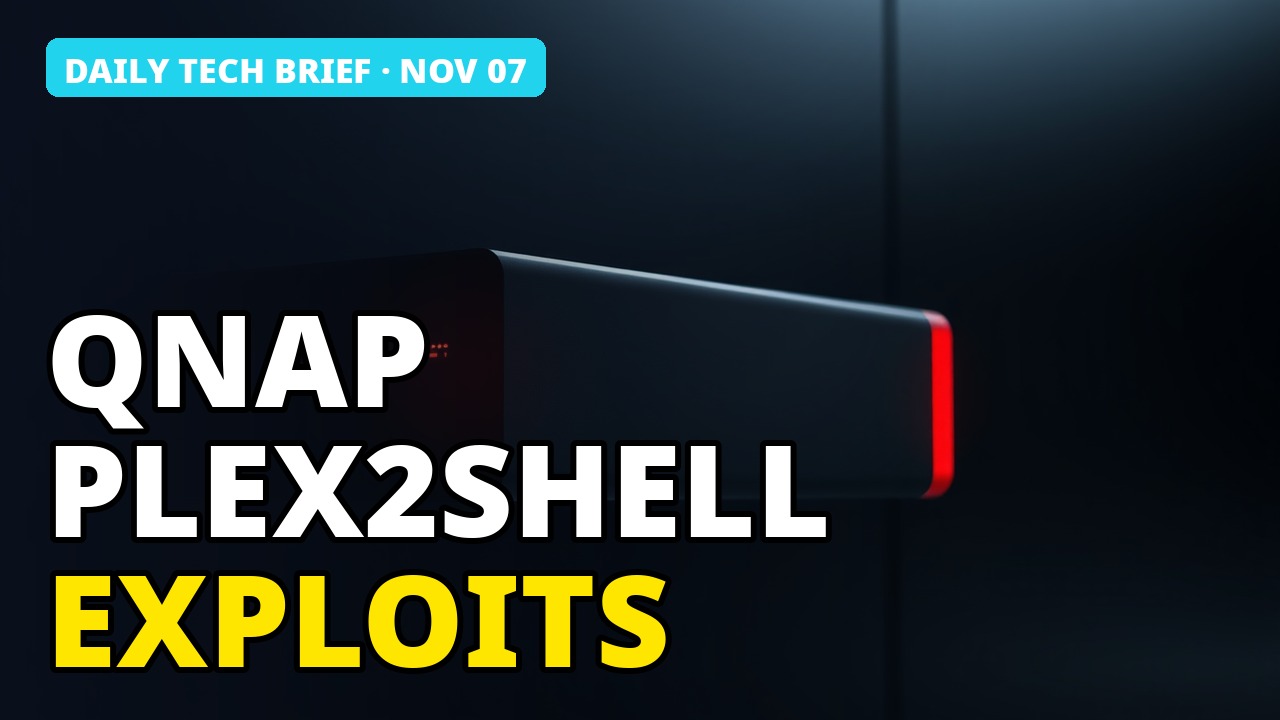
QNAP NAS Plex Media Server Plex2Shell Active Exploitation
QNAP has warned that hackers are actively exploiting the Plex2Shell vulnerability chain in Plex Media Server on its NAS devices. The vendor said it received multiple reports of suspected compromises and its PSIRT confirmed the flaws exist only in Plex Media Server, not in QTS or QuTS hero, according to Siber Güvenlik Haberleri.
Plex2Shell comprises four vulnerabilities (CVE-2026-96652, CVE-2026-96654, CVE-2026-96655, CVE-2026-96656) discovered by researcher Zach Main and reported to Plex on July 27. Exploitation began after full technical details were published on October 16, and CISA added all four to its Known Exploited Vulnerabilities catalog on October 20, urging federal agencies to upgrade to Plex 1.43.3.10861 or later within three days, as reported by Siber Güvenlik Haberleri.
QNAP advises users to update Plex Media Server to the latest version (1.43.3.10861) via the QNAP App Center, but warns that updating will not remove any payloads already installed. The vendor recommends treating exposed NAS devices as compromised, checking for signs of compromise, performing a clean OS reinstall, and resetting credentials. Users should disable remote Plex access or use VPN, and QNAP offers a remediation guide and log investigation via its support portal, per Siber Güvenlik Haberleri.
Why it matters: For IT professionals, active exploitation of a four‑vulnerability chain in a widely deployed media server on NAS appliances demands immediate patching, compromise assessment, and potential full OS reinstallation to ensure system integrity. For everyday people, personal media libraries, backups, and sensitive files stored on a NAS could be accessed, stolen, or encrypted by attackers if the Plex server is exposed to the internet.
Google Cloud is shifting from manual agent building to automatic agent creation via the Gemini app, which constructs agents from natural language and uses skills to execute tasks. The company says it has long provided tools for runtimes, model preferences, and workflow builders, but now Gemini app builds agents automatically using just a person’s words, according to Google Cloud Press Corner.
The new agentic workflows enable users to describe what they need in plain language, and the system assembles the appropriate agents and orchestrates skills to get work done. This reduces the engineering burden of manually coding agent logic and makes AI assistants more accessible through conversation rather than technical configuration, as stated by Google Cloud Press Corner.
Why it matters: For IT professionals, this shift reduces the engineering burden of manually coding agent logic by enabling natural-language agent creation and automated skill orchestration. For everyday people, it means more accessible, customizable AI assistants that can be summoned and directed through simple conversation rather than technical configuration.
Microsoft Foundry fal Generative Media Partnership
Microsoft Foundry has partnered with fal to bring generative media models to the platform, offering more models and possibilities for video and motion generation on Azure. The integration allows users to turn any idea into motion starting from an image, with one idea yielding many experiences, according to Microsoft Press Kits & News.
The partnership spans creative exploration to production, letting users choose the right model for each use case. Microsoft’s tagline “Explore what’s possible” underscores the expanded capabilities for building dynamic video content from static images using AI, as noted by Microsoft Press Kits & News.
Why it matters: For IT professionals, this integrates fal’s generative media models into Microsoft’s Foundry platform, expanding AI model options for building video and motion generation applications on Azure. For everyday people, it enables more accessible creation of dynamic video content from static images using AI.
Google Cloud Knowledge Catalog Semantic Layer Connectors
Google Cloud Knowledge Catalog Studio now automatically indexes semantic layers from Looker, BigQuery Graph, dbt MetricFlow, Databricks Unity Catalog, Snowflake, and SAP, allowing AI agents to ground responses in certified business semantics. Users can ask natural-language questions to search across the organization or within a specific GCP project, and each answer dynamically builds a visual context graph showing data assets, semantic models, and their connections, per Google Cloud Press Corner video.
Clicking a node reveals schema, metrics, logic, definitions, joins, file paths, and lineage. The demo showed detailed expansions for BigQuery Graph, dbt MetricFlow, Databricks Unity Catalog, Snowflake, and SAP entries, including governance flags like PII markings, according to Google Cloud Press Corner video.
A grounded agent using Knowledge Catalog needed only three tool calls (kc_search_entries, kc_lookup_context, execute_sql) versus multiple calls for a control agent, reducing tool calls, latency, and token usage by almost 67%. The grounded agent correctly applied filters that the control agent missed, producing accurate results in four turns, as demonstrated by Google Cloud Press Corner video.
Why it matters: For IT professionals, this means AI agents can be grounded in certified, cross-platform business semantics — reducing hallucinations, cutting tool calls by ~67%, and lowering latency and token costs. For everyday people, it translates to more accurate, faster, and cost-effective AI-driven insights in the business applications they rely on, such as analytics dashboards and chatbots.
n8n — Google Cloud’s new agentic workflows simplify AI agent creation, and n8n provides a visual, code-capable platform to build and deploy such agents with full traceability. Try n8n to build AI agents visually or in code with 500+ integrations and self-hosted or cloud deployment options. Try n8n
Runpod — Developers accessing generative media models through Microsoft Foundry and fal will need scalable GPU infrastructure to deploy and run these models. Try Runpod for on-demand and serverless GPUs to train, fine-tune, and deploy AI models without managing infrastructure. Try Runpod
Affiliate disclosure: some links in this description are affiliate links. If you sign up through them, SysArticles may earn a commission at no extra cost to you. We only mention tools that are relevant to the story.
These developments highlight the accelerating pace of AI integration and the critical importance of timely vulnerability management across infrastructure.
This briefing is produced with AI assistance from the linked primary sources. Narration uses a synthetic AI news-anchor voice, built with Higgs Materials licensed from Boson AI USA, Inc.
Ali YAZICI is a Senior IT Infrastructure Manager with 15+ years of enterprise experience. While a recognized expert in datacenter architecture, multi-cloud environments, storage, and advanced data protection and Commvault automation , his current focus is on next-generation datacenter technologies, including NVIDIA GPU architecture, high-performance server virtualization, and implementing AI-driven tools. He shares his practical, hands-on experience and combination of his personal field notes and “Expert-Driven AI.” he use AI tools as an assistant to structure drafts, which he then heavily edit, fact-check, and infuse with my own practical experience, original screenshots , and “in-the-trenches” insights that only a human expert can provide.