Today’s briefing highlights advances in AI infrastructure efficiency, edge inference, autonomous vehicle reasoning, and container orchestration. NVIDIA’s DGX platform delivers 37% more GPUs per watt, Google Cloud’s Gemma 4 enables offline vector search, NVIDIA’s Alpamayo 2 Edge offers a 2B-parameter open reasoning model, Nvidia acquires Inception for $500M, and CNCF publishes a Kubernetes v1.37 upgrade checklist.
Listen to today’s briefing (podcast)
Key takeaways
NVIDIA DGX platform achieves 37% more GPUs and 49% higher token output per watt with integrated power and cooling.
Google Cloud’s Gemma 4 enables private, offline vector search and hybrid cloud routing for edge AI.
NVIDIA Alpamayo 2 Edge delivers a 2B-parameter open reasoning model optimized for DRIVE AGX Thor.
Nvidia acquires Inception for $500M to integrate diffusion-based language models into open-source Nemotron.
CNCF publishes Kubernetes v1.37 upgrade checklist to safely adopt new features and deprecations.
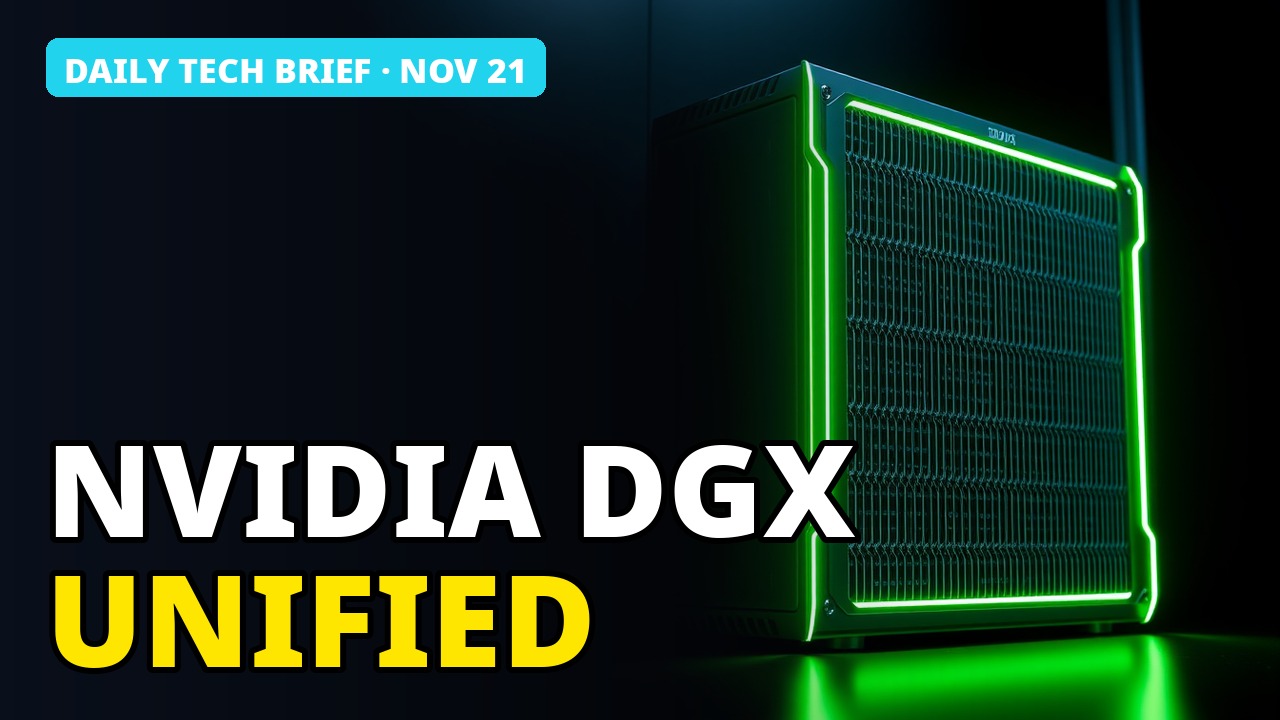
NVIDIA DGX platform unifies compute power cooling for energy-efficient AI factories
Insatiable demand for tokens is driving AI proliferation across every domain, while power remains a constrained commodity. NVIDIA’s DGX platform was chosen for its scalable design from build to software, according to NVIDIA Newsroom Multimedia.
The DGX reference design optimizes networking and liquid cooling, incorporating DGX SIM, DGX Flex, and Max LPS technologies. In an Iceland facility, dynamic power capping and throttling delivered the right power for maximum token performance, adding 37% more GPUs and achieving 49% more token output within the same power profile, as shown in NVIDIA Newsroom Multimedia.
DGX Flex enables dynamic power allocation with grid providers to use latent capacity and release it when needed, yielding a 40% capacity increase in the same energy footprint. NVIDIA plans to deploy 2 gigawatts using the DGX AI platform, making every megawatt more efficient, per NVIDIA Newsroom Multimedia.
Why it matters: The integrated compute, power, and cooling design delivers 37% more GPUs and 49% higher token output per watt, while dynamic grid interaction maximizes infrastructure utilization.
Google Cloud Gemma 4 enables local vector search and hybrid cloud routing
Google Cloud demonstrates running Gemma 4 models client-side in web browsers using WebGPU, WebAssembly, and WebNN, supporting up to 31 billion parameters with sufficient VRAM, according to a YouTube demonstration.
A new ‘vector search .js’ library creates semantic embeddings with a local vector database on GPU, searching 100,000 paragraphs in about 100 milliseconds offline. This targets medical, legal, and finance sectors for private on-device search, and combines with Gemma 4 for fully client-side RAG with zero per-token cost, as shown in the same demonstration.
While not state-of-the-art like cloud Gemini models, the local models are powerful. A hybrid approach uses latest Gemini models when cloud is available and falls back to locally preloaded Gemini 4 models offline, with progressive enhancement selecting larger models when more VRAM is present, per the demonstration.
Why it matters: Local vector search and hybrid routing enable private, low-latency AI inference on edge devices without cloud dependency, reducing costs and addressing data sovereignty.
NVIDIA Alpamayo 2 Edge brings compact reasoning model to vehicles on DRIVE AGX Thor
NVIDIA introduces Alpamayo 2 Edge, the first real-time reasoning model in the Alpamayo Open Platform for vehicle autonomy. The 2-billion-parameter model is Thor-compatible and outperforms all other open counterparts, according to NVIDIA Newsroom Multimedia.
First model in the platform trained via closed-loop reinforcement learning. Available open on Hugging Face. NVIDIA provides training recipes for fine-tuning to custom datasets and geographical areas, per NVIDIA Newsroom Multimedia.
Inference acceleration recipes optimize speed for applications. Early customer feedback positive, according to NVIDIA Newsroom Multimedia.
Why it matters: The open, compact reasoning model optimized for DRIVE AGX Thor with RL training and inference acceleration enables real-time autonomous driving development toward safer L4/L5 self-driving cars.
Nvidia acquires Inception for $500M to boost open-source Nemotron with diffusion models
Nvidia is nearing a deal to acquire AI startup Inception for at least $500 million, with performance bonuses for more than 30 employees at the two-year-old Bay Area startup, according to The Decoder citing The Information.
Inception builds language models using a diffusion process from image generation, refining full responses step-by-step rather than token-by-token. Its latest release is Mercury 3. The acquisition aims to bolster Nvidia’s open-source Nemotron models and physical models for robots, per The Decoder.
The move helps Nvidia compete with OpenAI and Anthropic as they build custom inference chips. Palantir and US government agencies already use Nemotron as an alternative to Chinese models. Talks began before Jensen Huang’s resignation and after Microsoft expressed interest. Co-founders Stefano Ermon, Aditya Grover, and Volodymyr Kuleshov are expected to join Nvidia, according to The Decoder.
Why it matters: The acquisition signals a shift toward diffusion-based language models that could improve inference efficiency and expand open-source Nemotron capabilities for robotics and enterprise AI.
Kubernetes v1.37 upgrade preparation checklist released by CNCF
CNCF released an upgrade preparation checklist for Kubernetes v1.37, urging teams to evaluate before enabling new features. First, review detailed release notes, deprecation and migration guides; verify clusters for deprecated components; and read migration guides, according to The Linux Foundation.
Second, examine new features, especially alpha features. The project relies on user feedback for improvements; enable features, test use cases, and provide feedback via GitHub issues or SIG Slack. Try as many features as possible, per The Linux Foundation.
Beta features are generally safe. Assess your cluster and scenario for potential issues before encountering them, according to The Linux Foundation.
Why it matters: The checklist helps IT professionals safely upgrade clusters and test AI-focused features without production disruptions, keeping cloud services reliable.
Runpod — Runpod offers on-demand GPU cloud infrastructure that aligns with the story’s focus on scalable, energy-efficient AI compute resources. Explore Runpod’s serverless GPU platform to train and deploy AI models without managing physical infrastructure. Try Runpod
Kubernetes Book on Amazon — A Kubernetes book helps you prepare for cluster upgrades like v1.37. See current options and reviews on Amazon. View on Amazon
Affiliate disclosure: some links in this description are affiliate links. If you sign up through them, SysArticles may earn a commission at no extra cost to you. We only mention tools that are relevant to the story. As an Amazon Associate I earn from qualifying purchases.
These developments underscore the industry’s push for efficiency, privacy, and openness across AI factories, edge devices, and cloud-native platforms. Watch for further integration of diffusion models and real-time reasoning in production systems.
This briefing is produced with AI assistance from the linked primary sources. Narration uses a synthetic AI news-anchor voice, built with Higgs Materials licensed from Boson AI USA, Inc.
Ali YAZICI is a Senior IT Infrastructure Manager with 15+ years of enterprise experience. While a recognized expert in datacenter architecture, multi-cloud environments, storage, and advanced data protection and Commvault automation , his current focus is on next-generation datacenter technologies, including NVIDIA GPU architecture, high-performance server virtualization, and implementing AI-driven tools. He shares his practical, hands-on experience and combination of his personal field notes and “Expert-Driven AI.” he use AI tools as an assistant to structure drafts, which he then heavily edit, fact-check, and infuse with my own practical experience, original screenshots , and “in-the-trenches” insights that only a human expert can provide.