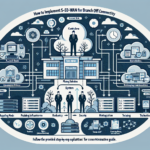
Edge environments are more vulnerable than centralized data centers: they’re distributed, physically exposed, and run diverse endpoints. Here’s how to secure them.
1. Network security
Use VPNs, TLS, or IPsec to protect traffic between edge devices, data centers, and cloud platforms.
Adopt Zero Trust: every device, user, and application must authenticate and be verified.
Segment with VLANs and microsegmentation to isolate edge devices and stop lateral movement.
Deploy firewalls at each edge location to monitor and block unauthorized traffic.
2. Harden edge devices
Authenticate every device before it joins the network — certificates or secure tokens.
Keep firmware and software current; unpatched vulnerabilities are the easiest entry point.
Limit administrative access, enforce least privilege, and require MFA on management interfaces.
Disable unused services, ports, and protocols to shrink the attack surface.
3. Data protection
Encrypt data at rest and in transit.
Collect and store only what the edge operation requires. Don’t send sensitive data unless you must.
Use checksums and digital signatures to verify integrity during transmission.
4. Physical security
Restrict physical access with locks, cameras, and controlled zones.
Use tamper-evident or tamper-responsive hardware that alerts on physical compromise.
Monitor temperature, humidity, and power to catch environmental threats early.
5. Endpoint security
Run EDR on edge devices for real-time threat detection and response.
Deploy anti-malware built for resource-constrained edge environments.
Automate patching so devices stay current without manual intervention.
6. Backup and disaster recovery
Keep local backups at the edge for fast recovery during outages or ransomware.
Replicate critical data to a central data center or cloud for redundancy.
Write a DR plan that accounts for remote, distributed edge sites — not just the core.
7. Kubernetes and containers at the edge
Enforce strict RBAC to control user access.
Isolate workloads with namespaces to prevent cross-application compromise.
Scan container images for vulnerabilities before deployment.
Manage secrets with HashiCorp Vault or Kubernetes Secrets — never hardcode them.
8. AI and GPU security at the edge
Encrypt models to prevent theft and reverse engineering.
Secure inference pipelines with authenticated APIs and restricted input sources.
Isolate GPU workloads using virtualization (e.g., NVIDIA vGPU) to prevent unauthorized access.
9. Monitoring and threat detection
Centralize logs with a SIEM to monitor edge devices from one place.
Use anomaly detection to spot unusual behavior at the edge.
Integrate threat intelligence feeds to catch emerging attacks early.
10. Regulatory compliance
Map edge data flows to GDPR, HIPAA, or other regulations that apply to your industry.
Maintain audit-ready logs for compliance and forensics.
11. Automation and orchestration
Enforce security configs across edge environments with Ansible, Puppet, or Terraform.
Use an orchestration platform to keep policies consistent across distributed sites.
12. Regular security assessments
Run penetration tests on edge infrastructure on a schedule.
Scan devices with tools like Nessus or Qualys to find weak points.
Re-evaluate risk periodically and adjust your posture.
13. Secure supply chain
Source hardware and software from trusted vendors only.
Require secure boot and trusted execution environments (TEE) to mitigate supply-chain attacks.
14. Incident response
Build playbooks specifically for edge scenarios — remote compromise looks different than data-center compromise.
Ensure you can remotely isolate or shut down a compromised edge device to contain the blast radius.
Ali YAZICI is a Senior IT Infrastructure Manager with 15+ years of enterprise experience. While a recognized expert in datacenter architecture, multi-cloud environments, storage, and advanced data protection and Commvault automation , his current focus is on next-generation datacenter technologies, including NVIDIA GPU architecture, high-performance server virtualization, and implementing AI-driven tools. He shares his practical, hands-on experience and combination of his personal field notes and “Expert-Driven AI.” he use AI tools as an assistant to structure drafts, which he then heavily edit, fact-check, and infuse with my own practical experience, original screenshots , and “in-the-trenches” insights that only a human expert can provide.