1. Define Use Cases and Requirements
- Identify workloads that need low latency, high bandwidth, or real-time processing — AI inference, IoT, video analytics.
- Clarify the business objectives: reducing latency, improving performance, offloading central datacenter resources.
- Assess how the edge solution will scale over time and accommodate future needs.
2. Plan the Edge Architecture
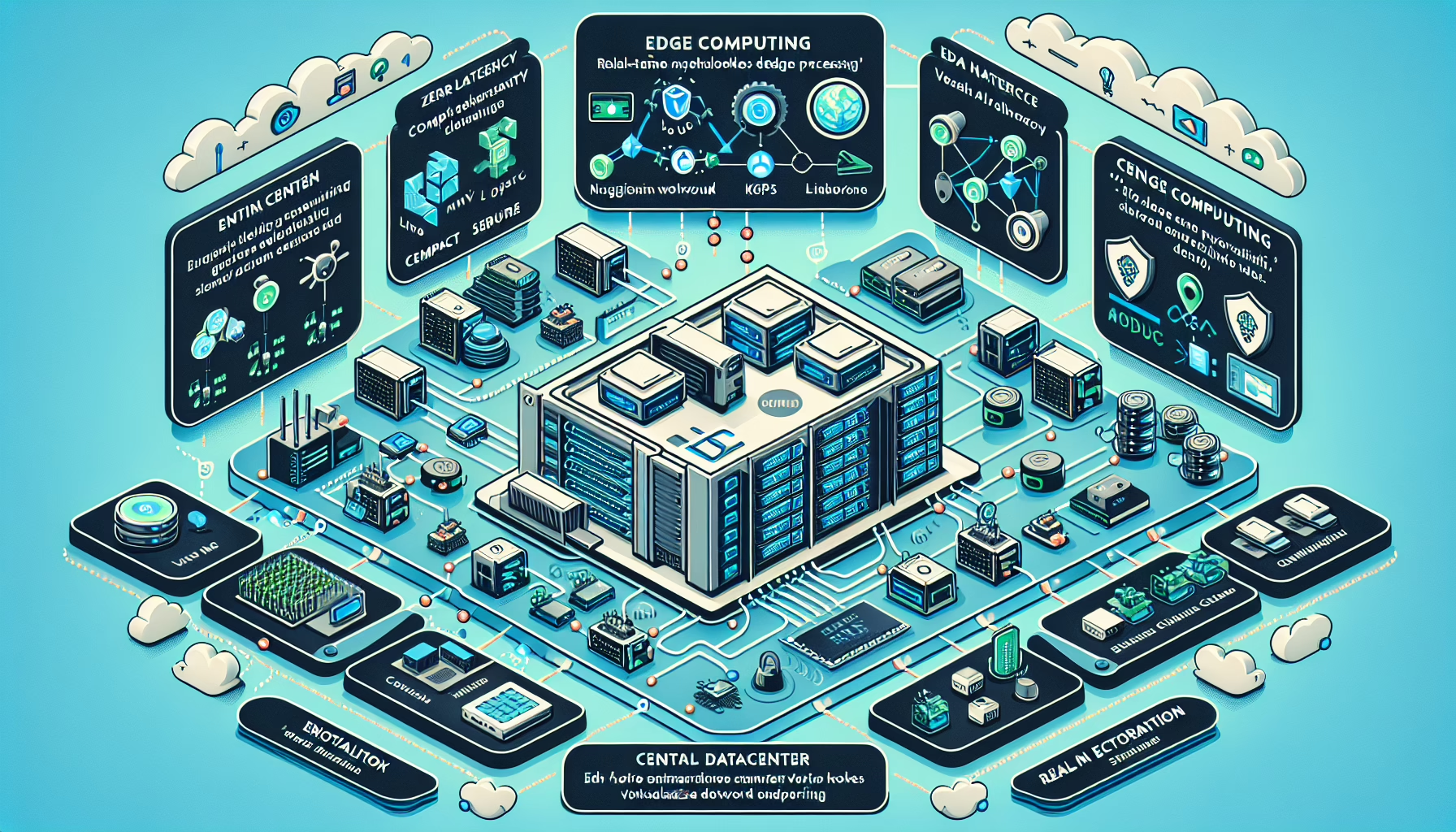
- Design a decentralized architecture that places compute closer to where data is generated — near IoT devices or end users.
- Deploy edge nodes (micro-datacenters or microservers) that operate independently but can communicate with the main datacenter.
- Ensure low-latency connectivity between edge nodes and the central datacenter using SD-WAN or dedicated links.
3. Select Hardware for Edge Computing
- Choose compact, energy-efficient servers built for edge environments; they must handle high-performance local processing.
- Add GPU acceleration suited to the workload — NVIDIA RTX series for inference, Jetson modules for space-constrained deployments.
- Implement high-speed, durable storage (NVMe or SSDs) for real-time processing and local caching.
- For harsh conditions, specify ruggedized hardware rated for temperature, vibration, and dust.
4. Deploy Virtualization and Containerization
- Run hypervisors such as VMware vSphere, Microsoft Hyper-V, or KVM to manage edge VMs.
- Orchestrate containers with Kubernetes or lightweight distributions like K3s or MicroK8s.
- Automate node provisioning with Infrastructure as Code tools — Terraform, Ansible.
5. Implement AI and Machine Learning at the Edge
- Deploy frameworks that run locally: TensorFlow Lite, PyTorch Mobile, ONNX Runtime.
- Optimize models for edge devices through quantization or pruning to cut resource demands.
- Use GPU-powered edge devices for inferencing tasks.
6. Ensure Reliable Networking
- Use SD-WAN or MPLS for high-speed, low-latency links between edge nodes and the datacenter.
- Leverage 5G where devices need ultra-low latency and high bandwidth.
- Implement edge caching (CDN-style) to reduce backhaul traffic and improve response times.
7. Focus on Security
- Encrypt data in transit and at rest on every edge device.
- Adopt a Zero Trust model for access control between edge and datacenter.
- Harden endpoints with firewalls, intrusion detection, and anti-malware.
8. Monitoring and Management
- Centralize monitoring with Prometheus, Grafana, or Datadog across edge nodes and the core.
- Run real-time analytics platforms to visualize and act on edge-generated data.
- Manage devices remotely via Redfish or IPMI when physical access isn’t practical.
9. Backup and Disaster Recovery
- Keep local backups at the edge for fast recovery.
- Replicate critical data to the main datacenter or cloud for redundancy.
- Develop a DR plan specific to edge nodes — failover scenarios, rapid restoration procedures.
10. Test and Optimize
- Start with pilot deployments; refine the model based on actual performance metrics.
- Stress-test edge nodes under peak loads to expose bottlenecks.
- Continuously update hardware, patches, and configurations as the environment evolves.
Tools and Technologies to Consider
- Hardware: Dell EMC PowerEdge XE servers, NVIDIA Jetson, HPE Edgeline servers.
- Software: VMware Tanzu, OpenShift, K3s, Kubernetes.
- Networking: Cisco SD-WAN, Juniper Contrail, Silver Peak edge solutions.
- AI frameworks: TensorFlow Lite, ONNX Runtime, NVIDIA Triton Inference Server.
Challenges
- Resource constraints: edge devices have far less capacity than a central datacenter.
- Scalability: managing hundreds or thousands of nodes demands orchestration that scales.
- Security: distributed locations are inherently harder to secure than a single facility.

Ali YAZICI is a Senior IT Infrastructure Manager with 15+ years of enterprise experience. While a recognized expert in datacenter architecture, multi-cloud environments, storage, and advanced data protection and Commvault automation , his current focus is on next-generation datacenter technologies, including NVIDIA GPU architecture, high-performance server virtualization, and implementing AI-driven tools. He shares his practical, hands-on experience and combination of his personal field notes and “Expert-Driven AI.” he use AI tools as an assistant to structure drafts, which he then heavily edit, fact-check, and infuse with my own practical experience, original screenshots , and “in-the-trenches” insights that only a human expert can provide.
If you found this content valuable, [support this ad-free work with a coffee]. Connect with him on [LinkedIn].
Related Posts: