Design your datacenter for redundancy from the ground up. Here’s what that looks like in practice:
1. Design for Redundancy
Geographic redundancy: Use multiple datacenters in different regions to survive regional disasters.
Power redundancy: Run diverse power feeds, UPS units, and generators so no single point kills the floor.
Network redundancy: Connect to multiple ISPs with redundant paths. Run BGP for automatic failover.
Cooling redundancy: Deploy N+1 or 2N cooling so a chiller loss doesn’t overheat the room.
Hardware redundancy: RAID for storage, dual power supplies in every server, multiple NICs.
2. Implement High Availability Architectures
Clustered servers: Group servers so workloads fail over automatically when a node dies.
Load balancing: Distribute traffic across the cluster. Make the load balancers redundant too.
Automated failover: Configure critical services to fail over without manual intervention.
3. Use Disaster Recovery Solutions
Replication: Replicate data and workloads to a secondary site or cloud. Tools like VMware Site Recovery Manager, Zerto, and Azure Site Recovery handle the orchestration.
RTO/RPO planning: Define Recovery Time and Recovery Point Objectives per system, then pick DR solutions that meet them.
Backup strategy: Schedule regular backups, store copies offsite or in cloud, and test restores routinely.
4. Leverage Virtualization and Containers
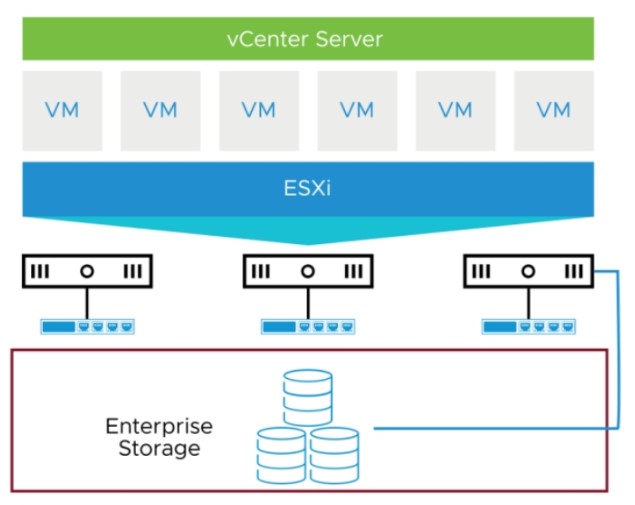
Virtual machines: Platforms like vSphere, Hyper-V, or KVM let you evacuate workloads from a failing host in seconds.
Kubernetes: Orchestrate containers with self-healing and automatic rescheduling across nodes.
Live migration: Enable hypervisor live migration to move running VMs during maintenance or pre-failure.
5. Implement Software-Defined Solutions
Software-Defined Storage (SDS): vSAN, Nutanix, or Ceph pool local disks into a redundant, scalable datastore.
Software-Defined Networking (SDN): Programmatic control lets you reroute traffic around failures instantly.
Software-Defined Datacenter (SDDC): Unify compute, storage, and network under one automation plane.
6. Utilize Cloud for Hybrid Redundancy
Hybrid cloud: Extend on-prem capacity to public cloud for burst and failover targets.
Cloud backup and DR: Use AWS Backup, Azure Backup, or Google Cloud DR for offsite recovery without a second physical site.
7. Monitoring and Testing
Monitoring: Deploy Nagios, Zabbix, SolarWinds, Datadog, or similar. Alert on power, thermal, network, and service health.
Regular failover testing: Run scheduled cutover drills and full DR simulations. Verify RTO/RPO in practice.
8. Automate Failover and Recovery
Automation tools: Ansible, Terraform, or Puppet to provision, configure, and rebuild infrastructure consistently.
9. Documentation and SOPs
Runbooks: Write step-by-step failover and recovery procedures for every critical service.
Configuration management: Keep a live inventory of hardware, software versions, and network topology.
10. Compliance and SLA Adherence
Compliance standards: Align redundancy with ISO 22301, GDPR, HIPAA, or other applicable frameworks.
SLAs: Define uptime and recovery commitments with stakeholders and measure against them.
Ali YAZICI is a Senior IT Infrastructure Manager with 15+ years of enterprise experience. While a recognized expert in datacenter architecture, multi-cloud environments, storage, and advanced data protection and Commvault automation , his current focus is on next-generation datacenter technologies, including NVIDIA GPU architecture, high-performance server virtualization, and implementing AI-driven tools. He shares his practical, hands-on experience and combination of his personal field notes and “Expert-Driven AI.” he use AI tools as an assistant to structure drafts, which he then heavily edit, fact-check, and infuse with my own practical experience, original screenshots , and “in-the-trenches” insights that only a human expert can provide.