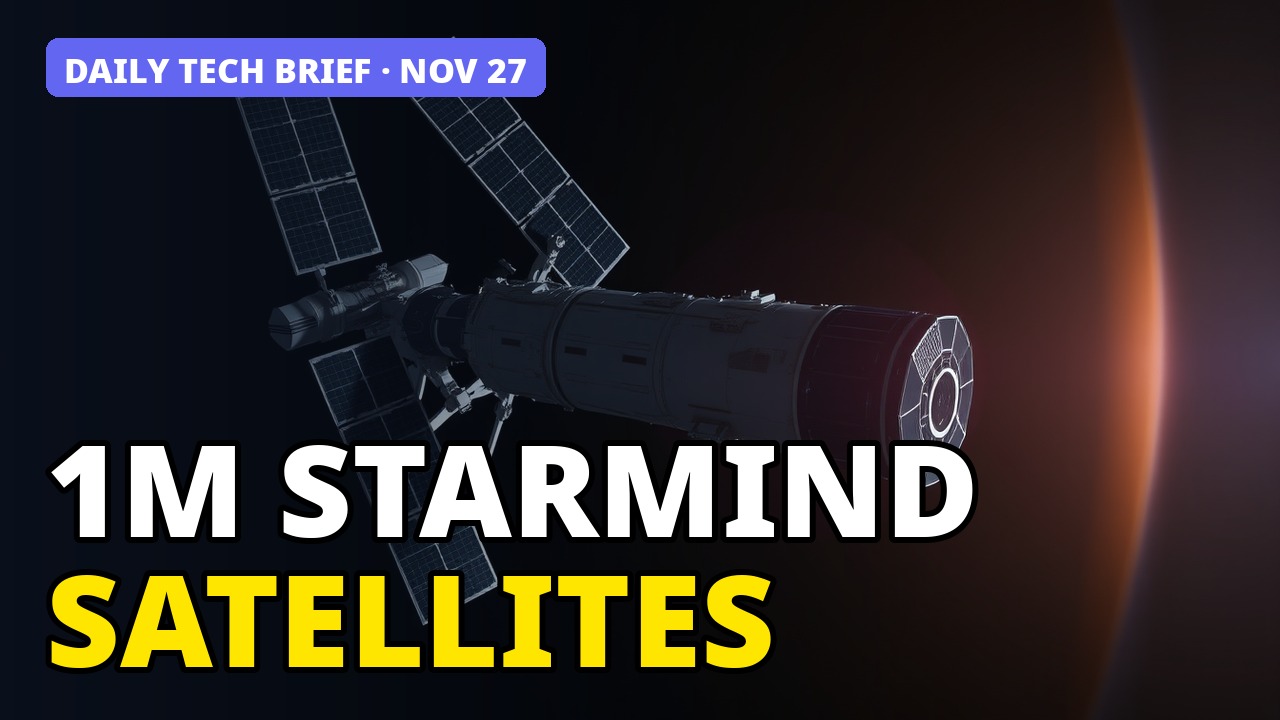
The FCC has greenlit SpaceX’s ambitious Starmind constellation of up to one million orbital AI data-center satellites, while NVIDIA released CUDA 13.5 with Vera Rubin support and Windows on Arm for DGX Station. Both moves signal a shift toward distributed, heterogeneous compute infrastructure for AI workloads.
Listen to today’s briefing (podcast)
Key takeaways
FCC authorizes SpaceX to deploy 1 million Starmind satellites for orbital AI data centers by 2040
NVIDIA CUDA 13.5 adds Vera Rubin architecture support and Windows on Arm for DGX Station
MPS v3 and CUDA Tile kernels enable smarter multi-GPU resource sharing and compute-communication overlap
SpaceX Starmind FCC Authorization 1 Million Satellites Orbital AI Data Centers
The Federal Communications Commission has authorized SpaceX to deploy up to 1 million satellites for the Starmind constellation, a fleet of orbital compute modules designed to serve as AI data centers in space according to The Decoder. The constellation aims to meet part of the rapidly growing demand for AI computing power on Earth by moving workloads to orbit.
The FCC also approved radio links that let SpaceX monitor and control the satellites if their primary optical inter-satellite connections fail, adding a resilience layer for the massive deployment. The rollout timeline targets 2040 for full deployment, marking a multi-decade infrastructure build.
Why it matters: Orbital AI data centers could alleviate terrestrial capacity and power constraints while offering low-latency compute to underserved regions.
NVIDIA CUDA 13.5 Vera Rubin Windows Arm DGX Station
NVIDIA has released CUDA 13.5 with general availability support for the upcoming Vera Rubin architecture and extended Windows on Arm support to the DGX Station for Windows, as detailed in the NVIDIA Newsroom Multimedia briefing. The release includes code walkthroughs for placing work and data on multi-die GPUs, sharing GPUs via Multi-Process Service (MPS), and calling SIMT library functions from CUDA Tile kernels in public preview.
MPS v3 introduces the ability to lend idle streaming multiprocessors (SMs) to busy workloads, improving utilization across concurrent processes. CUDA Tile kernels can now combine computation with communication across NVLink-connected GPUs, reducing synchronization overhead. Getting-started guidance covers driver compatibility, CUB tuning in CCCL 3.5, and batched copies in CUDA Python.
Why it matters: CUDA 13.5 equips developers with finer-grained multi-GPU control and new kernel abstractions that accelerate AI/HPC training and inference on next-generation hardware.
CUDA Programming Book on Amazon — The CUDA 13.5 release adds Vera Rubin support and Windows on Arm for DGX Station, making a CUDA programming guide a practical next step for developers. See current options and reviews on Amazon. View on Amazon
As an Amazon Associate I earn from qualifying purchases.
Space-based compute and smarter GPU runtime tools together expand the infrastructure options for AI at scale. Expect more cross-layer optimization as orbital and terrestrial resources converge.
This briefing is produced with AI assistance from the linked primary sources. Narration uses a synthetic AI news-anchor voice, built with Higgs Materials licensed from Boson AI USA, Inc.
Ali YAZICI is a Senior IT Infrastructure Manager with 15+ years of enterprise experience. While a recognized expert in datacenter architecture, multi-cloud environments, storage, and advanced data protection and Commvault automation , his current focus is on next-generation datacenter technologies, including NVIDIA GPU architecture, high-performance server virtualization, and implementing AI-driven tools. He shares his practical, hands-on experience and combination of his personal field notes and “Expert-Driven AI.” he use AI tools as an assistant to structure drafts, which he then heavily edit, fact-check, and infuse with my own practical experience, original screenshots , and “in-the-trenches” insights that only a human expert can provide.