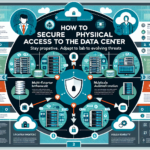
Physical security protects your datacenter from unauthorized access, theft, vandalism, and natural disasters. Here are the practices that matter:
1. Site Selection
- Pick a location outside flood zones, earthquake faults, and other natural disaster risks.
- Avoid highly visible or easily accessible sites that draw unwanted attention.
2. Perimeter Security
- Install fencing that defines a clear boundary.
- Place bollards or concrete barriers to stop vehicle attacks.
- Light the exterior well enough to deter intruders and let guards see clearly.
3. Access Control
- Limit entry points so you can monitor them effectively.
- Require multi-factor authentication: key cards, PINs, biometrics (fingerprint, facial recognition, iris).
- Log every visitor with a management system, not just a paper book.
- Use mantraps — two sequential locked doors — so only one authenticated person enters at a time.
4. Surveillance
- Cover all entry points, hallways, server rooms, and critical areas with high-resolution cameras.
- Monitor feeds 24/7, either by trained staff or automated alerts.
- Retain footage securely for a defined period; know your legal and operational requirements.
5. On-Site Security Personnel
- Hire trained guards for monitoring and rapid response.
- Schedule patrols inside and outside the facility on a random but frequent basis.
- Make sure every guard knows the incident response plan cold.
6. Internal Physical Barriers
- Restrict server room access to authorized personnel only, using the same access control as the perimeter.
- Lock server racks to prevent hardware tampering.
- Secure cable runs so they can’t be pulled or cut accidentally or maliciously.
7. Environmental Controls
- Install fire detection and clean-agent suppression (e.g., FM-200, Novec 1230) — water sprinklers destroy gear.
- Keep temperature and humidity in the ASHRAE recommended ranges; monitor continuously.
- Use raised floors and proper drainage to handle leaks or flooding.
8. Redundant Infrastructure
- Back every power path with UPS and generators; test transfer switches monthly.
- Run diverse network paths from different providers or POPs.
9. Auditing and Monitoring
- Log every access event — badge swipes, biometric reads, mantrap cycles — and keep logs tamper-proof.
- Run internal security audits quarterly; bring in a third party annually.
- Do physical penetration tests: try to tailgate, bypass mantraps, pick locks, clone badges.
10. Policies and Procedures
- Write clear policies for access provisioning, revocation, visitor escort, and incident escalation.
- Train all staff — not just security — on tailgating awareness, badge hygiene, and emergency procedures.
- Run background checks on anyone with unescorted access to critical areas.
11. Emergency Preparedness
- Maintain a tested disaster recovery plan with defined RTO/RPO for physical incidents.
- Mark emergency exits clearly; equip them with crash bars and alarms that alert security when opened.
- Run drills for fire, intrusion, and natural disasters at least twice a year.
12. Layered Defense
- Stack controls: perimeter, lobby, mantrap, server room, rack. No single point should grant full access.

Ali YAZICI is a Senior IT Infrastructure Manager with 15+ years of enterprise experience. While a recognized expert in datacenter architecture, multi-cloud environments, storage, and advanced data protection and Commvault automation , his current focus is on next-generation datacenter technologies, including NVIDIA GPU architecture, high-performance server virtualization, and implementing AI-driven tools. He shares his practical, hands-on experience and combination of his personal field notes and “Expert-Driven AI.” he use AI tools as an assistant to structure drafts, which he then heavily edit, fact-check, and infuse with my own practical experience, original screenshots , and “in-the-trenches” insights that only a human expert can provide.
If you found this content valuable, [support this ad-free work with a coffee]. Connect with him on [LinkedIn].
Related Posts: