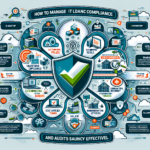
Financial institutions handle sensitive data under strict regulation, and threats are getting more sophisticated. If you manage this infrastructure, you need a layered security approach. Here’s how to build it:
1. Understand Regulatory and Compliance Requirements
- Know the regulations: PCI DSS, GDPR, ISO 27001, SOX, and local rules like FFIEC in the U.S.
- Stay audit-ready: keep systems, policies, and processes aligned so you don’t scramble during exams.
- Run periodic compliance checks, not just annual audits.
2. Implement Strong Access Controls
- Role-based access control (RBAC): limit access by role. Only DBAs touch production financial databases.
- Multi-factor authentication (MFA) everywhere: critical systems, admin accounts, remote access, no exceptions.
- Principle of least privilege: users and service accounts get the minimum access needed.
- Privileged access management (PAM): vault, rotate, and monitor every privileged credential.
3. Network Security
- Segment networks: isolate payment processing, customer databases, and backup storage from general traffic.
- Deploy next-gen firewalls and IDS/IPS to inspect and block malicious traffic.
- Apply Zero Trust: verify every connection and identity before granting access, even inside the perimeter.
- Require VPN with strong encryption for all remote access.
4. Endpoint Security
- Run endpoint protection: antivirus, anti-malware, and EDR on every managed device.
- Patch aggressively: OS, applications, firmware — automate where possible, track compliance.
- Enforce full-disk encryption on laptops, desktops, and mobile devices.
5. Data Protection
- Encrypt data at rest and in transit. AES-256 minimum; manage keys in an HSM or KMS.
- Mask sensitive data in non-production environments — real customer data doesn’t belong in dev/test.
- Deploy DLP to detect and block unauthorized data exfiltration.
- Back up regularly and test restores. Ransomware recovery depends on it.
6. Server and Virtualization Security
- Harden every server: disable unused services, ports, and accounts. Follow CIS benchmarks for Linux and Windows.
- Secure the hypervisor: isolate VMs, patch the host, monitor VM escape attempts. Use built-in features in vSphere or Hyper-V.
7. Kubernetes and Container Security
- Use namespaces and network policies to isolate workloads.
- Enforce pod security standards: drop capabilities, run non-root, read-only root filesystem.
- Scan every container image for vulnerabilities before it hits a registry.
- Monitor runtime behavior with Falco, Sysdig, or similar to catch drift and exploits.
8. Threat Detection and Response
- Ingest threat intelligence feeds relevant to finance (FS-ISAC, vendor feeds, open source).
- Run behavioral analytics on network, endpoint, and user activity to spot anomalies rules miss.
- Automate containment with SOAR playbooks: isolate hosts, block IPs, reset credentials on trigger.
9. Backup and Recovery
- Keep immutable backups — object lock, WORM, or vendor equivalents — so ransomware can’t encrypt them.
- Store critical copies air-gapped or in a separate security domain.
- Replicate across geographic regions for disaster recovery; test failover quarterly.
10. Continuous Monitoring and Logging
- Centralize logs in a SIEM: Splunk, Elastic, Sentinel, or equivalent. Correlate across sources.
- Collect logs from servers, network gear, applications, cloud services, and security tools.
- Staff or contract 24/7 monitoring. Alerts at 3 AM need a response, not an email.
11. Employee Training and Awareness
- Run phishing simulations quarterly. Track click rates and target repeat offenders.
- Deliver role-based security training: developers get secure coding, finance gets BEC awareness, ops gets incident reporting.
- Make reporting easy and blame-free. A reported suspicious email is a win.
12. Incident Response Planning
- Define an IR team with clear roles: commander, comms, forensics, legal, executive sponsor.
- Maintain runbooks for ransomware, data breach, DDoS, insider threat, and cloud account compromise.
- Test with tabletop exercises and red-team engagements at least annually.
13. Vendor and Third-Party Risk Management
- Assess vendor security posture before onboarding: questionnaires, SOC 2 reports, penetration test summaries.
- Contractually require MFA, encryption, breach notification, and right-to-audit clauses.
- Monitor third-party access continuously; revoke immediately on contract end.
14. Physical Security
- Control datacenter access with biometrics or keycards; log every entry.
- Cover all entry points with CCTV; retain footage per retention policy.
- Protect against fire, water, and power loss: suppression, raised floors, UPS, generator testing.
15. Regular Vulnerability Assessments and Penetration Testing
- Scan internal and external assets weekly; prioritize CVSS 7+ with exploitability.
- Run annual penetration tests by an independent firm; scope includes cloud, APIs, and physical.
- Remediate critical findings in 72 hours, high in 30 days. Track to closure.
16. Stay Current
- Subscribe to vendor advisories and CISA KEV catalog; patch known-exploited vulnerabilities first.
- Participate in FS-ISAC or similar sharing groups; you’re not the only target.
17. Budget and Staffing
- Fund security tools and infrastructure refresh as operational expense, not capital exception.
- Hire or retain specialists for cloud security, IR, and application security. Generalists can’t cover it all.

Ali YAZICI is a Senior IT Infrastructure Manager with 15+ years of enterprise experience. While a recognized expert in datacenter architecture, multi-cloud environments, storage, and advanced data protection and Commvault automation , his current focus is on next-generation datacenter technologies, including NVIDIA GPU architecture, high-performance server virtualization, and implementing AI-driven tools. He shares his practical, hands-on experience and combination of his personal field notes and “Expert-Driven AI.” he use AI tools as an assistant to structure drafts, which he then heavily edit, fact-check, and infuse with my own practical experience, original screenshots , and “in-the-trenches” insights that only a human expert can provide.
If you found this content valuable, [support this ad-free work with a coffee]. Connect with him on [LinkedIn].
Related Posts: