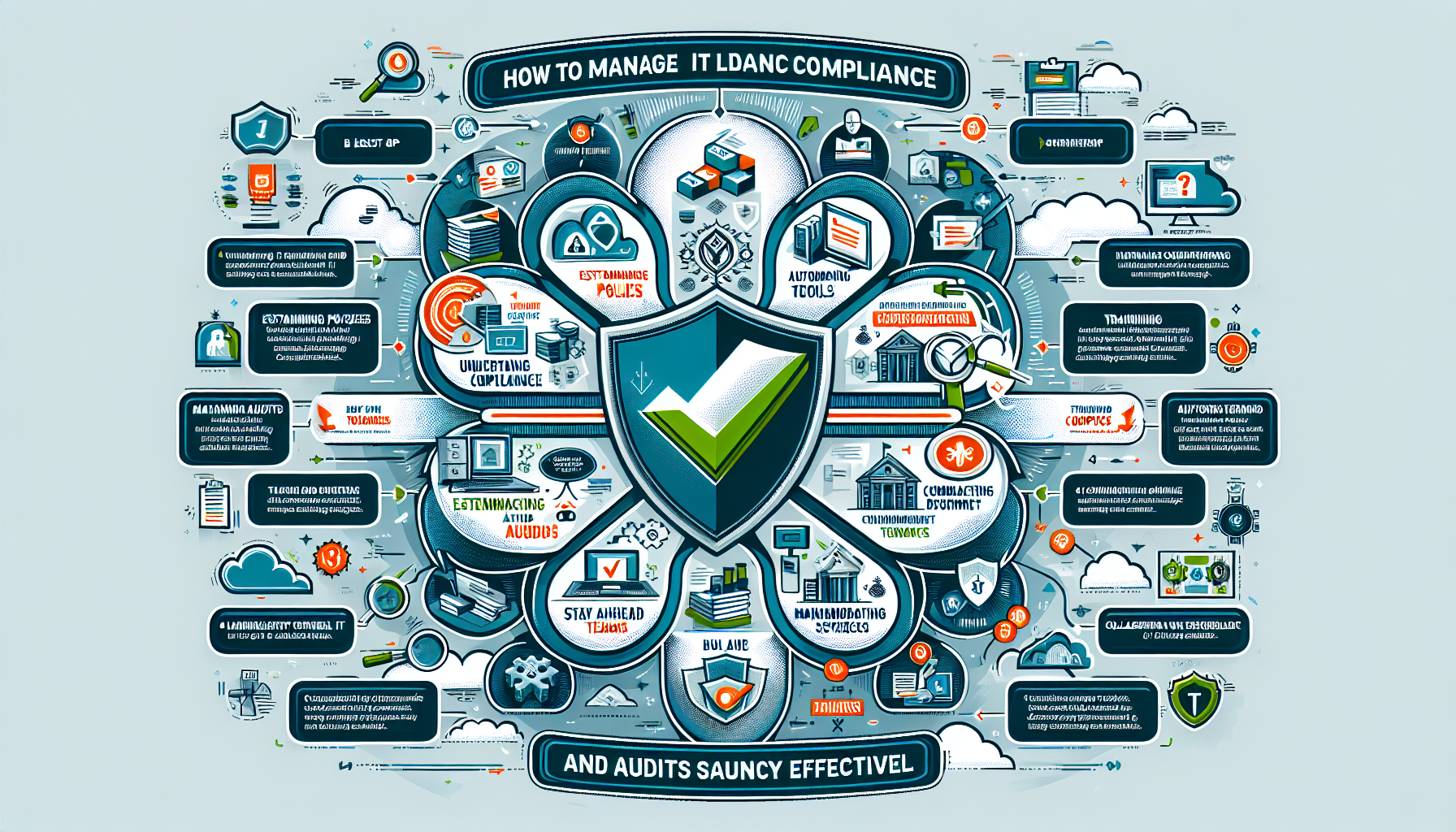
IT compliance and audits keep your infrastructure aligned with regulations, standards, and internal policy. Here’s how to run the program without drowning in paperwork.
1. Understand Compliance Requirements
Identify the standards that apply — GDPR, HIPAA, PCI DSS, SOX, ISO 27001, or others — and read the actual control language.
Map each requirement to the IT components it touches: datacenters, servers, virtualization hosts, storage arrays, network gear, cloud accounts.
2. Establish Policies and Procedures
Write enforceable IT policies for access control, data retention, backup, encryption, and incident response.
Create step-by-step SOPs for the tasks auditors will ask about: provisioning accounts, rotating keys, restoring backups, handling a breach.
Review and update policies quarterly or whenever a regulation, business process, or system changes.
3. Implement Monitoring and Auditing Tools
Centralize logs with ELK Stack, Splunk, or a SIEM so you can search across servers, storage, and network devices in one place.
Manage configuration with Ansible, Puppet, or Chef to keep systems in a known, compliant state.
Run vulnerability scans (Nessus, Qualys) on a schedule and track remediation to closure.
4. Automate Compliance Where Possible
Use cloud provider compliance frameworks (AWS Artifact, Azure Policy, Google Cloud Security Command Center) to inherit controls and generate evidence.
Automate backup and retention with Veeam, Rubrik, or native snapshots so retention policies are enforced by default.
In Kubernetes, deploy Falco or Aqua Security to enforce runtime policies and audit container activity.
5. Maintain Comprehensive Documentation
Keep a live inventory of every server, VM, Kubernetes cluster, storage volume, and cloud resource.
Preserve audit trails: who accessed what, when, and what changed — immutable if possible.
Draw data-flow diagrams showing where regulated data enters, moves, and exits your environment.
6. Conduct Regular Internal Audits
Run self-audits against the same checklists external auditors use; fix gaps before they find them.
Build checklists per standard (PCI DSS 12 requirements, ISO 27001 Annex A controls, etc.) and assign owners.
Stage mock audits with a cross-functional team to test documentation completeness and response time.
7. Train and Educate Your Team
Require annual compliance training for all IT staff; cover the specific controls they operate daily.
Run phishing simulations and incident-reporting drills so non-IT employees know their role.
8. Collaborate with Stakeholders
Meet monthly with legal and compliance officers to align on regulatory changes and audit scope.
Involve HR for personnel-data privacy, finance for SOX-relevant systems, and procurement for vendor risk.
9. Stay Ahead of Changes
Subscribe to regulator feeds (EU DPB, HHS OCR, PCI SSC) and set calendar reminders for enforcement dates.
Add upcoming changes to your change-management backlog so they’re scoped and resourced early.
10. Leverage External Expertise
Hire a qualified third-party auditor for the annual attestation; their independence carries weight with regulators.
Bring in a specialist consultant for complex scopes (e.g., FedRAMP, HITRUST) rather than learning on the job.
11. Address Specific IT Domains
Datacenter and hardware: verify physical access logs, CCTV retention, and visitor escort procedures meet the standard.
Storage and backup: encrypt data at rest (AES-256 minimum), test restores quarterly, and lock retention policies against deletion.
Virtualization and Kubernetes: enforce RBAC, network policies, and admission controllers; audit cluster roles monthly.
Windows and Linux: apply CIS benchmarks, automate patching, and disable unused services and accounts.
AI/ML systems: document training data provenance, model versioning, and access controls for any system processing regulated data.
GPU workloads handling sensitive data: confirm memory encryption (where hardware supports it) and isolate workloads via MIG or separate nodes.
12. Follow Up on Audit Findings
For every finding, write a remediation plan with owner, deadline, and evidence of fix; track in your ticketing system.
Feed root causes back into policy, automation, and training so the same issue doesn’t recur.
Ali YAZICI is a Senior IT Infrastructure Manager with 15+ years of enterprise experience. While a recognized expert in datacenter architecture, multi-cloud environments, storage, and advanced data protection and Commvault automation , his current focus is on next-generation datacenter technologies, including NVIDIA GPU architecture, high-performance server virtualization, and implementing AI-driven tools. He shares his practical, hands-on experience and combination of his personal field notes and “Expert-Driven AI.” he use AI tools as an assistant to structure drafts, which he then heavily edit, fact-check, and infuse with my own practical experience, original screenshots , and “in-the-trenches” insights that only a human expert can provide.