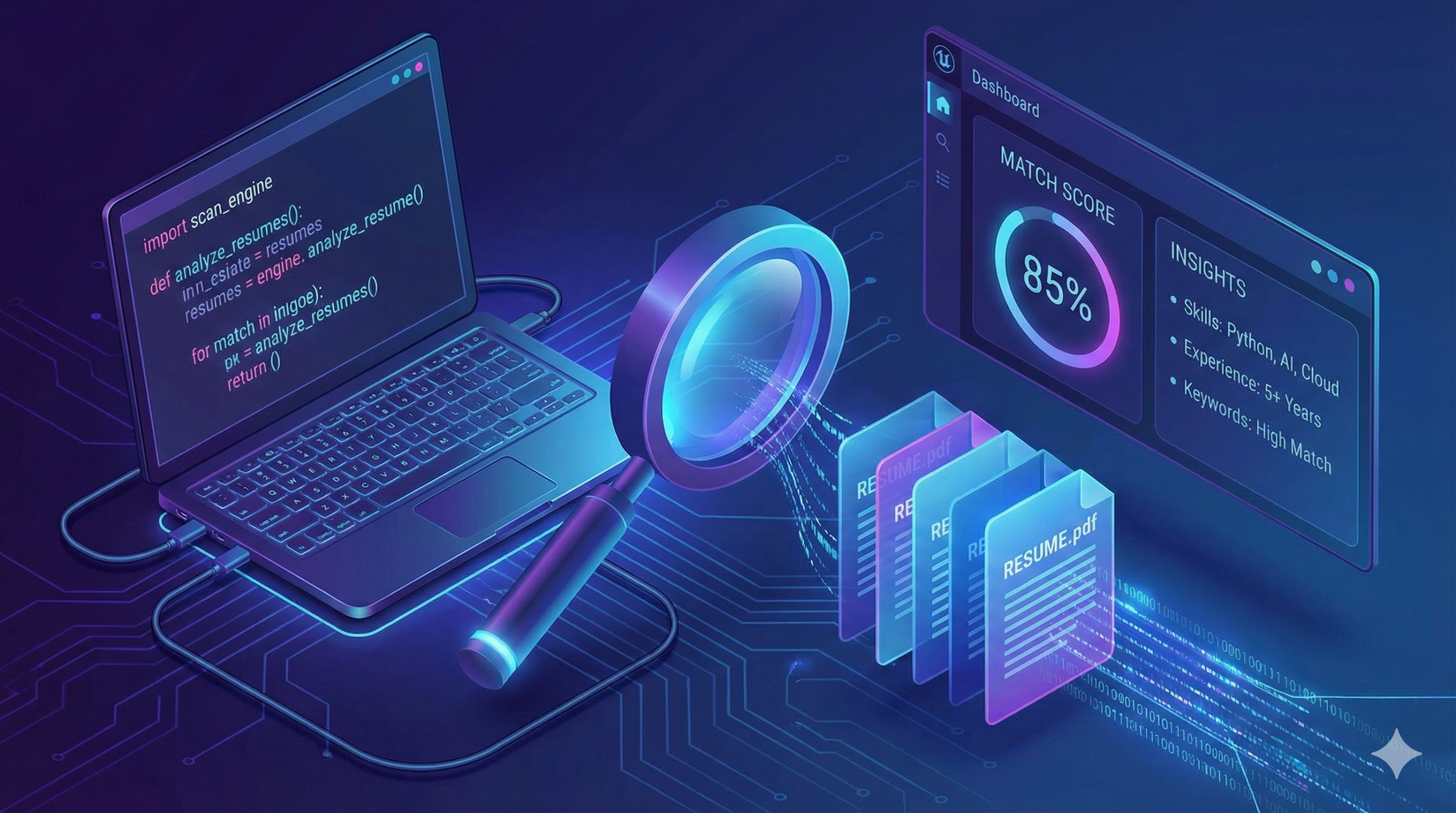
Reviewing thousands of job applications is a bottleneck for every hiring manager. Traditional “filtering” methods often fail to distinguish talent from noise. In this post, I share how I built a privacy-first, Local LLM-based “Decision Support System” prototype. It reduces screening time by 90% and ensures data privacy, allowing me to focus on what matters: people.
The Problem: Signal vs. Noise
One of the biggest bottlenecks in technology management is talent acquisition. Opening a popular position often results in an influx of over 2000 applications.
Reviewing every single resume manually takes weeks of valuable management time.
Standard “Relevance” algorithms often rely on rigid keyword matching, missing context and delivering poor rankings.
Spam applications and “keyword stuffing” techniques make it harder to spot genuinely qualified candidates.
The Solution: AI-Powered Pre-Screening Assistant
To solve this, I developed a “Candidate Pre-Evaluation Assistant” using Python and Local LLM technologies. This system is not a “decision-maker”; it is an insight generator for the manager.
How It Works: The system reads legally downloaded candidate profiles (PDFs) and performs a semantic analysis based on “Must-Have” and “Nice-to-Have” criteria, generating a structured recommendation report.
Privacy First: No data is sent to the cloud. The entire process runs on a local machine, and data is deleted immediately after analysis.
ROI and Strategic Impact Analysis
Integrating this system shifts the manager’s role from “filtering noise” to “assessing talent.” Here are the estimated gains observed during the prototyping phase:
Metric
Traditional Method
AI-Assisted Method
Improvement
Time per Resume
10-15 Minutes
10-15 Seconds
~60x Speed
Shortlisting Cycle
Weeks
Minutes
90%+ Time Savings
Interview Quality
Generic Questions
Targeted/Gap-Oriented*
Quality Increase
Operational Load
High (Manual)
Low (Automated)
High Efficiency
*Interview Quality Note: By flagging specific missing skills or vague project descriptions (e.g., “Has Java experience but lacks project details”), the system empowers the interviewer to ask targeted validation questions, significantly deepening the technical interview.
The Future: Agentic AI
Today, this system is an “Assistant.” However, the future belongs to “Autonomous Agents” that will coordinate interview schedules and provide personalized feedback to candidates. The human factor will remain central as the “final decision-maker” and “ethical controller.”
The future belongs to leaders who collaborate with AI, not those who compete with it.
Legal Disclaimer: This work is a personal R&D project developed for educational purposes. It has been tested with synthetic/anonymous data. Final hiring decisions must always be made under human supervision.
Ali YAZICI is a Senior IT Infrastructure Manager with 15+ years of enterprise experience. While a recognized expert in datacenter architecture, multi-cloud environments, storage, and advanced data protection and Commvault automation , his current focus is on next-generation datacenter technologies, including NVIDIA GPU architecture, high-performance server virtualization, and implementing AI-driven tools. He shares his practical, hands-on experience and combination of his personal field notes and “Expert-Driven AI.” he use AI tools as an assistant to structure drafts, which he then heavily edit, fact-check, and infuse with my own practical experience, original screenshots , and “in-the-trenches” insights that only a human expert can provide.